
Commercial Tobacco Use
- Commercial Tobacco Use Home
- Data and Reports
- Get Help Quitting
- Prevention and Treatment
- Tobacco and Your Health
Learn More
- Behavioral Health and Commercial Tobacco
- E-cigarettes and Vaping
- Flavored Commercial Tobacco
- Menthol Commercial Tobacco
- Nicotine and Nicotine Dependence
- Nicotine Pouches and Other Emerging Products
- Promoting Quitting and Treatment
- Secondhand Smoke and Aerosol
- Smoke-Free Housing
- Traditional and Sacred Tobacco
Related Topics
Commercial Tobacco Use
- Commercial Tobacco Use Home
- Data and Reports
- Get Help Quitting
- Prevention and Treatment
- Tobacco and Your Health
Learn More
- Behavioral Health and Commercial Tobacco
- E-cigarettes and Vaping
- Flavored Commercial Tobacco
- Menthol Commercial Tobacco
- Nicotine and Nicotine Dependence
- Nicotine Pouches and Other Emerging Products
- Promoting Quitting and Treatment
- Secondhand Smoke and Aerosol
- Smoke-Free Housing
- Traditional and Sacred Tobacco
Related Topics
Contact Info
Commercial Tobacco Use
Prevention and Treatment
Commercial tobacco use, like smoking and vaping is the single greatest preventable cause of death and disease in Minnesota. And while the state’s overall smoking rate is below the national average, certain Minnesota communities are still at risk and suffer disproportionately from commercial tobacco-related death and disease.
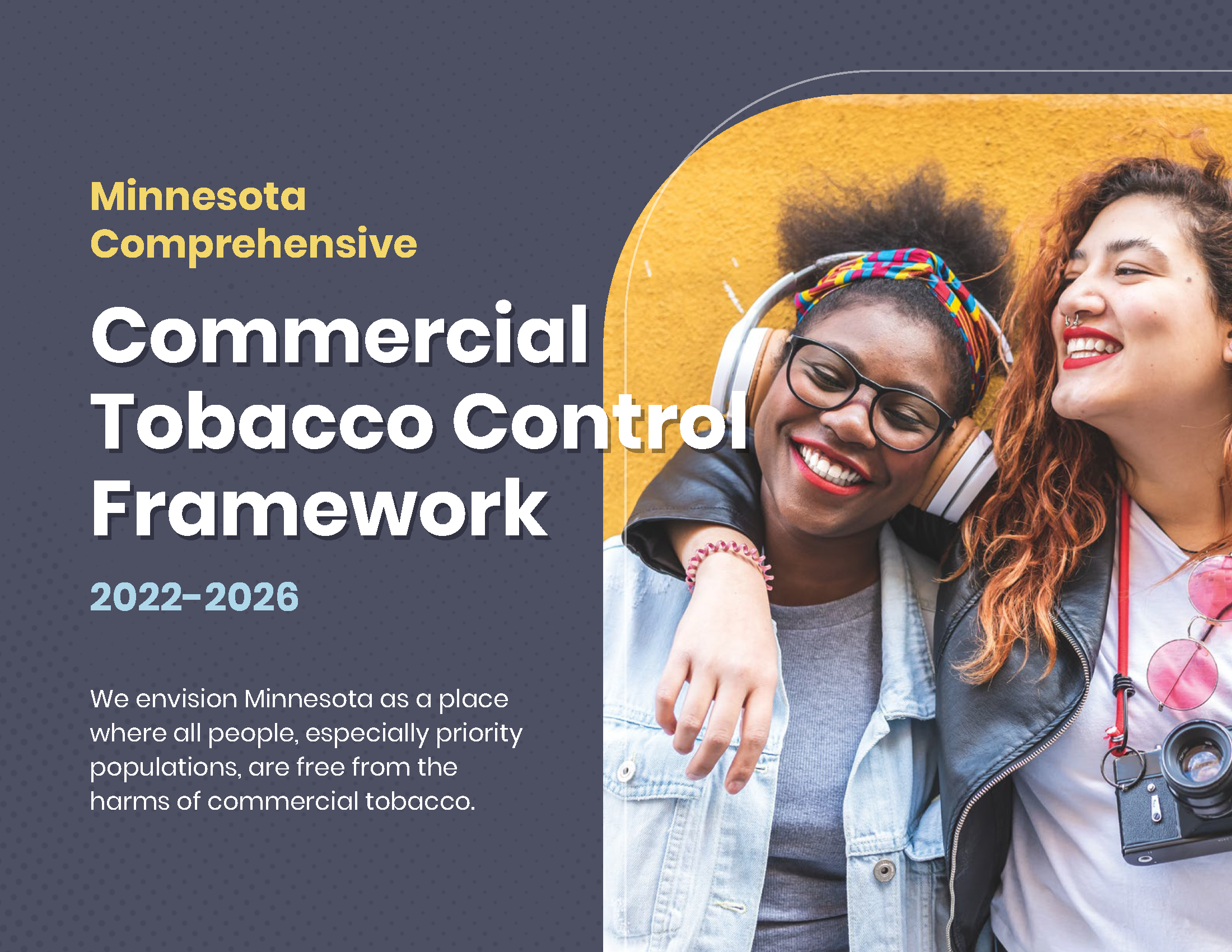
In Minnesota, we use a comprehensive approach to preventing and treating commercial tobacco use. The Minnesota Comprehensive Tobacco Control Framework 2022-2026 lays out an ambitious path to address commercial tobacco use. This framework serves as a guide for partners in Minnesota’s comprehensive commercial tobacco prevention and control efforts.
Preventing initiation among young people
Keeping youth from starting to smoke, vape, or use other commercial tobacco products is challenging due to the evolving product landscape and aggressive marketing by tobacco companies. The tobacco and nicotine industry spend billions of dollars each year on advertising and promotion, which expose and draw youth and young adults to their products online and in stores. Research demonstrates a direct link between this marketing and youth initiation. New products like e-cigarettes (vapes) and nicotine pouches, with their own unique marketing strategies, also add to the complexity of commercial tobacco control efforts.
Effective prevention requires a multi-faceted approach that includes statewide and community programs, policies, and mass media campaigns. These initiatives prioritize youth and young adults, as most people who use commercial tobacco begin before age 26.
Minnesota communities are working to prevent initiation by:
- Raising the age to purchase to 21: Nearly all people who use commercial tobacco start as teenagers. Tobacco 21 policies help prevent youth commercial tobacco use. Increasing the age gap between teens and those who can legally buy tobacco helps keep commercial tobacco out of the high school environment.
- Restricting flavored products: The tobacco industry uses flavors to market its products and attract new customers in specific communities, like young people, communities of color, and other population groups. Flavored commercial tobacco products can also be harder to quit.
- Increasing product prices: Increasing the price of commercial tobacco products is one of the most effective ways to prevent youth initiation. According to the U.S. Surgeon General, “significantly raising tobacco prices is the single most consistently effective tobacco prevention intervention for reducing tobacco use in the general population.” By making these products less affordable, we can reduce the devastating health and economic burdens caused by commercial tobacco use in our communities.
- Engaging young people: Commercial tobacco use almost always begins before age 18, making young people the primary target of industry marketing – but also powerful partners in prevention. Youth engagement brings genuine credibility, energy, and generational insight to local outreach. By empowering youth to lead campaigns and speak directly to decision-makers, communities can more effectively expose industry tactics, shift peer social norms, and drive lasting policy change. Learn more: Youth E-cigarette Prevention and Cessation Initiative
Data briefs
- SHIP supports local Tobacco 21 policies, helping to reduce youth commercial tobacco use (PDF)
- Minnesota Teens Vape Sweet and Minty Flavors (PDF)
- Minnesota Teens Prefer Commercial Tobacco Products with Flavors (PDF)
Stories from the field
Learn more
- E-cigarette Use Among Youth and Young Adults – A Report of the Surgeon General (2016) | U.S. Department of Health and Human Services (PDF)
- Preventing Tobacco Use Among Youth and Young Adults – A Report of the Surgeon General (2012) | U.S. Department of Health and Human Services (PDF)
- Best Practices User Guides: Youth Engagement in Tobacco Prevention and Control | Centers for Disease Control and Prevention (PDF)
Promoting quitting and treatment
Quitting commercial tobacco use has health benefits at any age and no matter how long or how much someone has used commercial tobacco. Most people who use commercial tobacco want to quit, but quitting can be hard. That’s because commercial tobacco products, like cigarettes, e-cigarettes, and chew contain nicotine, a highly addictive drug found naturally in tobacco.
There are proven treatments that can help people quit using commercial tobacco. These treatments include counseling, FDA-approved medications, web-based programs and text messaging programs. Many health insurance companies also provide commercial tobacco treatment services to their members. Health care providers, employers, educators, and other professionals can play an important role in connecting people who use commercial tobacco to free help to quit.
Minnesota communities are working help people quit by:
- Integrating treatment into health care: By making commercial tobacco treatment a routine part of healthcare, providers can identify and support patients who want to quit, leading to better health outcomes and reduced healthcare costs.
- Creating supportive workplaces: Workplace policies and practices that support treatment can make quitting commercial tobacco use easier for employees and can encourage them to use their treatment coverage.
- Making referrals to treatment services: Health care providers and community-based organizations can refer patients and clients to free quitting support services.
- Promoting free treatment programs: Organizations of all types can play a key role in connecting people to free resources for quitting commercial tobacco use. By actively promoting treatment programs, organizations can help eliminate barriers to access – such as cost, lack of awareness, or stigma – and empower individuals to seek help.
Learn more: Promoting Quitting and Treatment | Commercial Tobacco Use
Data briefs
Stories from the field
- Online Provider Training will Deliver Quit Services to More People with Mental Illness (PDF)
- Helping Smokers Reduce Stress of Poverty Is Key to Quitting (PDF)
- Latino Culture Informs Effort at CLUES to Help Smokers Quit (PDF)
Learn more
- Get Help Quitting | Commercial Tobacco Use
Free help is available to all people who live in Minnesota. - Smoking Cessation – A Report of the Surgeon General (2020) | U.S. Department of Health and Human Services (PDF)
- Best Practices User Guides: Cessation in Tobacco Prevention and Control | Centers for Disease Control and Prevention (PDF)
Eliminating secondhand smoke and aerosol exposure
Secondhand smoke comes from the use of combustible commercial tobacco products like cigarettes, cigars, or pipes. Secondhand aerosol is exhaled by a person using an e-cigarette (vaping). Secondhand smoke and aerosol expose bystanders to a range of chemicals that can harm their health.
Minnesota communities are bringing cleaner, safer air to residents by:
- Expanding smoke-free housing: Smoke-free housing policies are an effective way to ensure all residents and staff of multi-unit properties, like apartments or condominiums, have the right to breathe clean air in their homes or where they work. Learn more: Smoke Free Housing | Commercial Tobacco Use
- Creating commercial tobacco-free spaces: Public spaces and workplaces that are completely commercial tobacco free help ensure all people are able to breathe clean air.
- Promoting quitting and treatment: Organizations of all types can play a key role in connecting people to free resources for quitting commercial tobacco use. By actively promoting treatment programs, organizations can help eliminate barriers to access – such as cost, lack of awareness, or stigma – and empower individuals to seek help. Learn more: Promoting Quitting and Treatment | Commercial Tobacco Use
Data briefs
- Tobacco Use and Asthma (PDF)
- Smoking and Vaping around Youth who have Asthma (PDF)
- Smoke-free Housing Policies – Statewide Health Improvement Partnership (SHIP) Evaluation Study
Learn more
Identifying and eliminating tobacco-related disparities
Despite overall declines in commercial tobacco use among Minnesotans, many communities still suffer disproportionately from commercial tobacco use death and disease. Commercial tobacco-related disparities are created and affected by a complex mix of factors. Social determinants of health, tobacco industry influence, a lack of comprehensive commercial tobacco control policies, and changing community populations can contribute to and maintain these disparities.
Data briefs
- The Hidden Harms of Menthol: Ending the Legal Sales of Menthol Commercial Tobacco Products would Advance Health Equity in Minnesota (PDF)
- Teen Tobacco Use in Rural Minnesota (PDF)
Stories from the field
- Tobacco-Free Alliance Mobilizes Change Agents in St. Paul Area (PDF)
- Community at the Heart of Commercial Tobacco Prevention (PDF)
- Leadership Challenges Enhance On-the-Ground Tobacco Prevention (PDF)
- Champion for LGBTQ Health Sees Progress (PDF)
- Keep Traditions Alive. Keep Tobacco Sacred. (PDF)
- Cultural Connections Help Somalis Become Tobacco-Free (PDF)
- Traditional Tobacco Use Connects Native Youth to Culture, Community, and Health (PDF)
- Community Education: A Powerful Strategy for Reversing Tobacco Trends (PDF)
- Three Counties Partner for Tobacco-Free Communities (PDF)
- Trusted Group is Shifting Hmong Cultural Practices around Tobacco Use (PDF)
- Youth Voices are Powering Tobacco Law Changes (PDF)
- Shift MN: An LGBTQ Advocate against Commercial Tobacco Use (PDF)
Learn more
- Traditional Tobacco and American Indian Communities in Minnesota | Commercial Tobacco Use
- Eliminating Tobacco-Related Disease and Death: Addressing Disparities – A Report of the Surgeon General (2024) | U.S. Department of Health and Human Services (PDF)
- Best Practices User Guides: Health Equity in Tobacco Prevention and Control | Centers for Disease Control and Prevention (PDF)
- Best Practices User Guides: Tobacco Where You Live - Native Communities | Centers for Disease Control and Prevention (PDF)
Grants and statewide initiatives
We provide grants to local public health agencies, community organizations, and tribal governments to help reduce the burden of tobacco within their own communities. Grantees work toward commercial tobacco-free environments like smoke-free multi-unit housing, reducing youth access to commercial tobacco products, and promoting quitting and commercial tobacco use treatment.
The Commercial Tobacco-Free Communities Grant Program funds local community grants and technical assistance and training that aims to reduce and prevent youth commercial tobacco use and address commercial tobacco-related disparities in Minnesota by promoting community-driven prevention and cessation activities and strategies.
Grantees
- African Immigrant Community Services
- Ain Dah Yung Center
- American Lung Association
- Association for Non-Smokers - Minnesota
- Lao Assistance Center of Minnesota
- Minneapolis American Indian Center
- Neighborhood HealthSource
- NorthPoint Health and Wellness Center
- Sierra Leone Community in Minnesota
- Tobacco-free Alliance
- WellShare International
The Statewide Health Improvement Partnership supports community-driven solutions to expand opportunities for active living, healthy eating, and commercial tobacco-free living.
Learn more: Statewide Health Improvement Partnership
Tribal Tobacco grants provides opportunities for tribal communities to carry out culturally driven healthy eating, active living and commercial tobacco prevention strategies, while increasing access to and educating about the healing effects of traditional tobacco. The work is integrated in traditional activities, teachings and ceremonies.
Learn more
The 2021 Minnesota Legislature appropriated funds for the Minnesota Department of Health to administer a new initiative to address youth e-cigarette and other commercial tobacco product use and cessation. The initiative includes community grants, statewide technical assistance and training, a coordinated counter-marketing campaign, and surveillance and evaluation. The overall goal of this initiative is to reduce youth e-cigarette and commercial tobacco use in Minnesota by 25 percent by 2026.
Learn more: Youth E-cigarette Prevention and Cessation Initiative
Technical assistance and training providers are funded support community grantees in their commercial tobacco prevention and control work by ensuring they have the necessary knowledge, skills, and resources to be successful in achieving their goals. Providers offer a variety of education and skill building opportunities for grantees and community members, including one-on-one consultation, webinars, in-person grantee meetings, toolkits, model policy language, and other resources.
We conducted an extensive community input process to engage partners in how to use funds from Minnesota’s 2023 JUUL Settlement Agreement. In total, more than 250 people from communities across the state provided valuable input for this process.
Learn more: Community Input for Minnesota’s 2023 JUUL Settlement Funds
