
Transforming Minnesota's Public Health System
- Home: System Transformation
- About This Work
- Framework of Foundational Responsibilities
- Definitions, Criteria, and Standards for Fulfillment
- Joint Leadership Team
- Minn. Infrastructure Fund and Local Innovation Projects
- Governance Groups and Communities of Practice
- Data Modernization
- Regional Data Models
- Tribal Public Health Capacity and Infrastructure
- FPHR Grant: Funding for Foundational Responsibilities
- Reports, Fact Sheets, Resources
- News & Blog: Public Health System Transformation Update
- Message Toolkit
Related Sites
Contact Info
Two Minnesota Projects Recognized as Model Practices by National Organization
Public Health System Transformation Update Newsletter
August 13, 2026 | View all system transformation newsletters
In July 2026, the National Association of County and City Health Officials (NACCHO) recognized two Minnesota projects at its national conference in Kentucky. NACCHO will feature both projects in its Model Practices Database, for other local health departments to review and replicate.
Both of these projects demonstrate the value of updating how we do our work in public health: using modern tools to better meet communities’ needs and expectations, and using modern practices to find new and better ways to do foundational work.
Southeast Regional Data Model
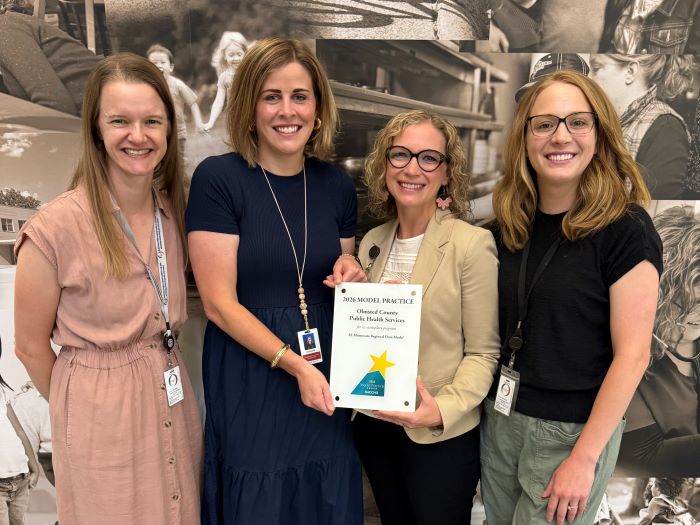
Southeast Regional Data Model staff celebrate recognition as a NACCHO model practice. Left to right: Megan Schroeder, Meaghan Sherden, Tina Jordahl, Jenny Passer. Photo credit: Olmsted County Public Health.
The Southeast Regional Data Model is a hub-and-spoke model spanning 11 counties, which centralizes the knowledge, skills, and abilities to access, collect, use, manage, and share population health data. Along with the Northwest 8 Collective model, the Southeast model helped Minnesota’s public health system learn about the infrastructure needed to ensure every community has access to just-in-time data for planning and decision-making. This model helps bridge data gaps and creates a smart, cost-effective way to strengthen local data capacity.
For the past four years, every single one of the counties participating said the Southeast Regional Data Model has met their data needs and is beneficial for their community. Before the State Community Health Services Advisory Committee (SCHSAC) dedicated funding specifically for regional data models around the state in 2025, counties had been ready to invest their own funding in the model, a signal of their faith and support in this collaboration.
This regional model is one of Minnesota's regional data models, and started as a locally-led innovation project supported by the Minnesota Public Health Infrastructure Fund.
- Learn more about what makes this a model practice: 2026 Model Practices Awards Gallery: Regional Data Model.
- Read more about this innovative data model in the July 2024 newsletter: Southeastern Minnesota: A region shares data, expertise, and partnership.
- Learn more about Minnesota's growing number of regional partnerships to tackle population health data: Regional Models to Collect, Use, and Share Local Population Health Data.
Dakota County Public Health scalable communications model
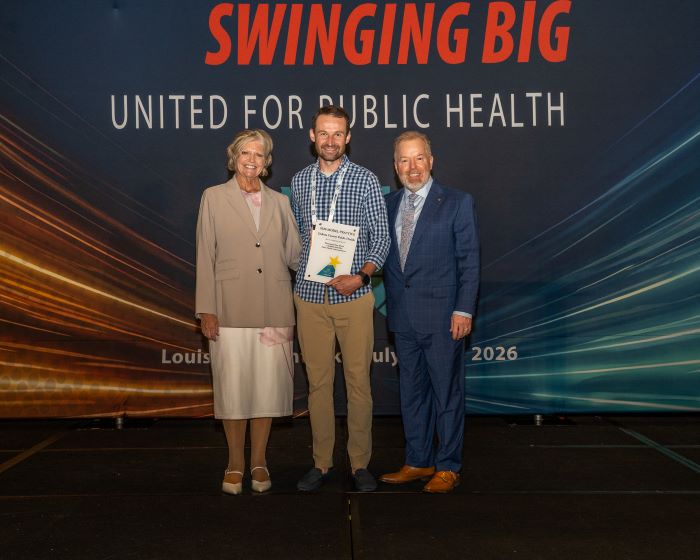
Matt Giljahn of Dakota County (center) accepts recognition as a model practice on behalf of Dakota County. Photo credit: National Association of County and City Health Officials.
Dakota County Public Health created a scalable planning model for public health communications model for more proactive and effective messaging to residents. With no additional staffing required, Dakota County Public Health used existing tools (like Word and Excel) and held monthly communication check-in meetings with program units, to build 12-month plans that helped teams navigate busy periods and reduce last-minute-requests.
After putting this approach into practice, Dakota County Public Health increased the number of completed projects per year from 80 to nearly 200. By having a disciplined approach to coordination and planning, staff were also able to navigate pop-up projects strategically instead of letting them take over the communications calendar (a universal struggle for all communicators).
Learn more about what makes this a model practice: 2026 Model Practices Awards Gallery: Planning the Year Ahead: A Scalable Model for Public Health Communications.