Secondary menu

  • About Us
  • News & Stories
  • Translated Materials
Minnesota Department of Health logo
  • Data, Statistics, and Legislation

    Data, Statistics, and Legislation

    Statistical reports, health economics, policy, and legislation.
    Data, Statistics, and Legislation
    • Community Health
    • Diseases and Conditions
    • Environmental Health
    • Health Behaviors and Risk Factors
    • Health Care Cost and Quality
    • Reporting and Exchanging Data
    • Legislation and Policy
  • Diseases and Conditions

    Diseases and Conditions

    A-Z disease listing, diseases and conditions by type.
    Diseases and Conditions
  • Health Care Facilities, Providers, and Insurance

    Health Care Facilities and Providers

    Directories of facilities, professional certifications, health insurance and patient safety.
    Health Care Facilities and Providers
    • Facility Certification, Regulation and Licensing
    • Insurance
    • Health Information Technology
    • Provider Certifications, Licenses, Registrations and Rosters
    • Patient Health and Safety
    • Health Care Homes
    • Notices Related to Health Records
    • Rural Health and Primary Care
    • Trauma System
  • Healthy Communities, Environments, and Workplaces

    Healthy Communities, Environments, and Workplaces

    Indoor air and drinking water quality, community prevention and emergency preparedness.
    Healthy Communities, Environments, and Workplaces
    • Community Wellness and Health Equity
    • Healthy Schools and Child Care
    • Healthy Businesses and Workplaces
    • Local Public Health
    • Environments and Your Health
    • Safety and Prevention
    • Emergency Preparedness and Response
    • Equitable Health Care Task Force
    • Transforming the Public Health System in Minnesota
  • Individual and Family Health

    Individual and Family Health

    Birth records, immunizations, nutrition and physical activity.
    Individual and Family Health
    • Vital Records and Certificates
    • Disabilities and Special Health Needs
    • Disease Prevention and Symptom Management
    • Healthy Aging
    • Healthy Children, Youth and Adolescents
    • Mental Health and Well-being
    • Reproductive Rights and Protections in Minnesota
    • Women and Infants
MDH Logo

Breadcrumb

  1. Home
  2. Healthy Communities, Environment and Workplaces
  3. Health Equity
  4. Health Equity Initiatives and Projects
Topic Menu

Health Equity

  • Health Equity Home
  • Capacity Building Requests
  • Funding Opportunities
  • Newsletters
  • Reports and Publications
  • Health Equity Networks

About Us

  • Division of Health Equity Strategy and Innovation
  • Office American Indian Health
  • Office of African American Health
  • Office of Diversity, Inclusion, Belonging, and Equity Strategy

Health Equity

  • Health Equity Home
  • Capacity Building Requests
  • Funding Opportunities
  • Newsletters
  • Reports and Publications
  • Health Equity Networks

About Us

  • Division of Health Equity Strategy and Innovation
  • Office American Indian Health
  • Office of African American Health
  • Office of Diversity, Inclusion, Belonging, and Equity Strategy
Contact Info
Health Equity Strategy and Innovation Division
651-201-5813
health.equity@state.mn.us

Contact Info

Health Equity Strategy and Innovation Division
651-201-5813
health.equity@state.mn.us

Capacity Strengthening Initiative

drawing of diverse crowd

MDH recognizes that community-based organizations (CBOs) are important partners in helping Minnesotans who face health challenges. New legislation (Minnesota statutes, chapter 144.9821) was adopted by the legislature in 2023 to empower and strengthen the capacity of CBOs. Through this legislation, MDH created the Capacity Strengthening Initiative to help CBOs be better equipped and prepared for success in procuring grants and contracts at the department and addressing inequities.

The initiative focuses on helping CBOs and faith-based groups that serve people of color, American Indians, LGBTQIA+ communities, and people with disabilities. It provides training and resources to these organizations.

This webpage has information and resources on applying for grants and contracts from MDH. Check this page often for updates about the Capacity Strengthening Initiative.

About grantees

Previous Grantee Initiatives

For grantees

Capacity Strengthening Grantee Portal - one stop shop for grantee guidelines, templates, and more. 

RFP

2023 Capacity Strengthening Initiative RFP

The basics

  • Vendor ID Registration
  • Getting Nonprofit Status

Grant resources

  • MDH Grant Opportunities
  • Minnesota Office of Grant Management
  • True Program Costs: Program Budget and Allocation Template and Resource
  • Transforming Business Models Primer Video - Propel Nonprofits
  • Annual Requirements for Nonprofit Organizations in Minnesota - Propel Nonprofits
  • Free Business Legal Help to Low-Income Entrepreneurs | LegalCORPS
  • Minnesota Council of Nonprofits
  • Wilder Foundation Research Topics
  • Nonprofit Board Lab 2024
  • Propel Nonprofits

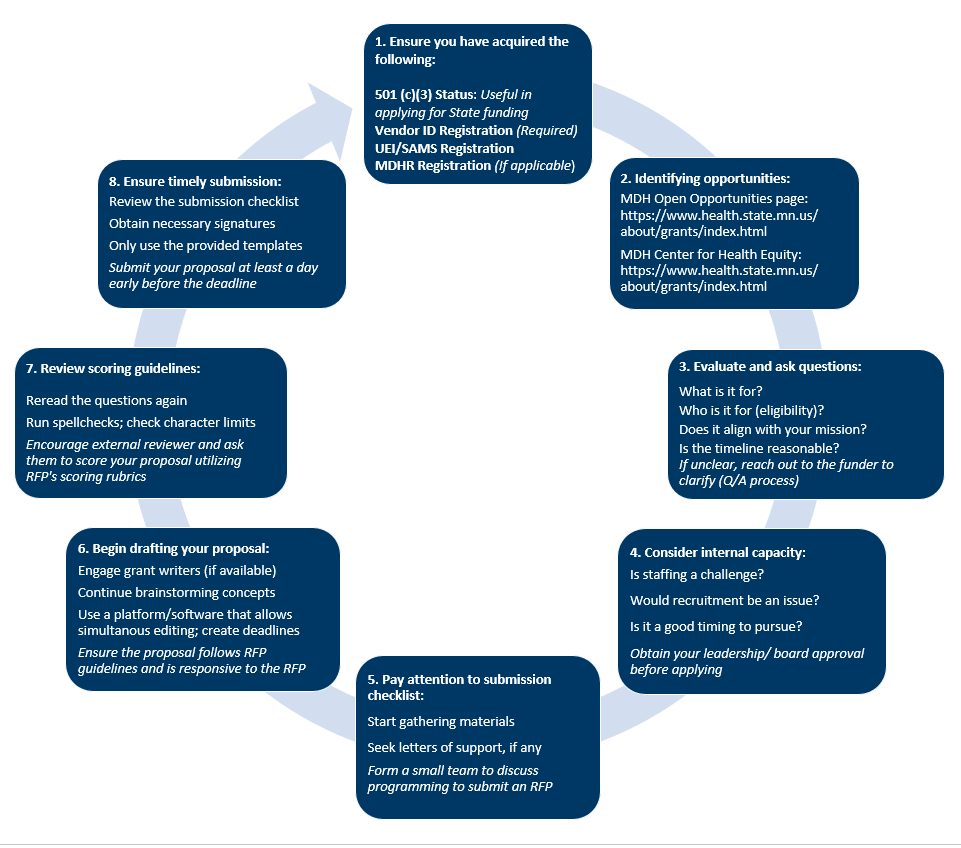
Applicant flowchart

applicant flowchart; description below image

  1. Ensure you have acquired the following:
    • 501(c)(3) status: useful in applying for State funding.
    • Vendor ID registration (required).
    • UEI/SAMS registration.
    • MDHR registration (if applicable).
  2. Identifying opportunities:
    • MDH Open Opportunities
    • MDH Health Equity Strategy and Innovation Division
  3. Evaluate and ask questions:
    • What is the opportunity for?
    • Who is the opportunity for?
    • Does the opportunity align with your mission?
    • Is the timeline reasonable?
    • Reach out to ask clarify questions.
  4. Consider internal capacity:
    • Do I have enough staffing to do the work?
    • Will I have to recruit staff to do the work?
    • Is it good timing for me to pursue this opportunity?
    • Do I need approval from my board or leadership?
  5. Pay attention to submission checklist:
    • Gather materials for the application and budget.
    • Seek letters of support, if needed.
    • Form a small team to discuss the programming and proposal.
  6. Begin drafting your proposal:
    • Choose a lead writer to write the application.
    • Work with your program team to plan the proposed work.
    • Use a platform that allows simultaneous review and editing (if needed).
    • Ensure the proposal meets all the requirements in the request for proposal (RFP).
    • Ensure the proposal responds to the RFP purpose or goal.
  7. Review scoring guidelines:
    • Ask internal and external reviewers to score your proposal using the RFP scoring rubrics.
    • Reread the RFP questions and your responses.
    • Run spellcheck and grammar check.
    • Make sure your proposal follows character or word counts (if any).
  8. Ensure timely submission:
    • Review the submission checklist.
    • Obtain necessary signatures.
    • Only use the templates provided.
    • Submit your proposal at least a day early before the deadline.
Tags
  • equity
Last Updated: 10/07/2025
  • Facebook
  • X
  • Instagram
  • LinkedIn
  • Youtube

About MDH

  • About Us
  • Grants and Loans
  • Advisory Committees

Legal & Accessibility

  • Privacy Policy
  • Equal Opportunity
  • Feedback Form

Careers at MDH

This is an official website of the State of Minnesota. Visit Minnesota.gov for more information.