
Children and Youth with Special Health Needs (CYSHN)
Programs
Contact Info
Hearing Loss
Early Hearing Detection and Intervention (EHDI)
The Minnesota Early Hearing Detection and Intervention (EHDI) program provides information and resources for Minnesota parents, families, and providers as they navigate newborn hearing screening, the follow-up process and planning to support a child who is identified as deaf or hard of hearing. Visit MN EHDI program to access information designed for families and providers.
Permanent childhood hearing loss is identified for about 150 infants born in Minnesota each year, with about 100 additional young children identified after the newborn period each year. Nationally, CDC data show 1.8 out of every 1000 infants screened at birth have some degree of hearing loss. This makes hearing loss one of the most common conditions present at birth. This prevalence rises to 6 per 1000 children with hearing loss by ages 3-17, due to children developing or identified with hearing loss later in childhood. Most babies who are deaf or hard of hearing are born to hearing parents and most often, these parents have no experience with hearing loss.
MDH recognizes that everyone has their own unique identity, and we respect the terms people want to use to identify themselves. People may self-identify as deaf, deafblind, hard of hearing, a person with hearing loss, DeafPlus, a person with a hearing difference, DeafDisabled, etc. MDH often uses “deaf, deafblind and hard of hearing,” in an all-inclusive manner. MDH might also use the term “hearing loss” when talking about a medical diagnosis.
The degree of hearing loss in MDH EHDI data systems is measured in decibels (dB). For children, a slight hearing loss ranges from 16-25 dB, a mild hearing loss ranges from 26 dB to 40 dB, moderate from 41 to 55 dB, moderately severe from 56 to 70, severe 71 to 90 dB, and a profound hearing loss > 90 dB HL. The degree of hearing loss can be the same or different in each ear.
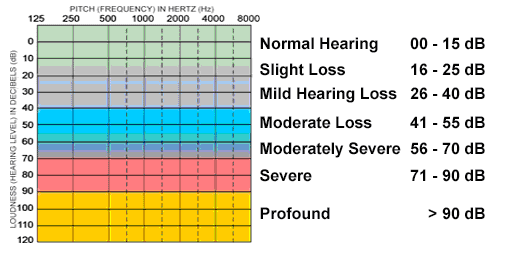
A child with a mild high frequency hearing loss might not hear or understand soft speech, speech from a distance, and speech with background noise. With moderate hearing loss the child might not hear conversations even at close distances. An audiogram, which is a graph, illustrates the type, degree, and configuration of hearing loss. To understand more about audiograms, visit American Speech-Language-Hearing Association: The Audiogram.
Infants in Minnesota receive a newborn hearing screening because language begins to develop at birth, and babies are often using their first words by about one year of age. The sooner hearing loss is identified, the sooner children who are deaf and hard of hearing can receive help and begin developing critical language skills.
Families will make numerous choices regarding how they communicate with their child and the types of educational services in which they would like their child to participate. Minnesota Low Incidence Projects has articles for parents about Exploring Communication Opportunities for Children with Hearing Differences.
Regular follow-up with audiology is important to monitor a child’s hearing levels and detect any hearing changes early. Amplification, including hearing devices, wireless accessories, cochlear implants or other assistive devices, may be options. Hearing devices are available for loan through the State of Minnesota Pediatric Hearing Device Loaner Program.
Minnesota's Early Intervention program, known as MN Part C Infant and Toddler Intervention Services, supports the development of children from birth up to three years of age with permanent (sensorineural, neural, conductive, mixed) and persistent (conductive) hearing loss in one or both ears. With early care and connection to intervention, families find support while their children are developing language and communication skills. Refer to early intervention through Minnesota Help Me Grow.
Minnesota's Early Hearing Detection and Intervention (EHDI) Program works to ensure that every baby who does not pass hearing screening has timely and appropriate follow-up. This includes an audiologic evaluation (hearing test) if needed. If a child is identified with hearing loss, Minnesota's EHDI program helps families access and connect with appropriate and timely intervention, statewide services, and needed resources.