
Title V Maternal and Child Health (MCH) Block Grant
Related MDH Links
Title V Maternal and Child Health 2025 Needs Assessment

The 2025 Title V Maternal and Child Health Needs Assessment Process
Every five years, the Minnesota Department of Health (MDH) conducts a comprehensive, community-focused needs assessment to gather information on the health and well-being of women, mothers, children and youth, including children and youth with special health needs (CYSHN), and their families. This assessment helps to provide direction on Title V Maternal and Child Health Block Grant program activities for the next five years by identifying statewide maternal and child health population priority needs. Ongoing needs assessment activities are also completed to keep apprised of emerging issues within maternal and child health populations. Priorities and strategies, in the form of a five-year action plan, are set and/or modified based on the needs of populations, federal requirements, Community Health Board priorities, and the capacity of MDH and local public health (LPH) agencies.
The statewide health assessment focuses on the following populations:
- Women, pregnant women, and mothers
- Infants
- Children
- Adolescents
- Children and youth with special health needs
The following questions are being used to guide the 2025 Title V Needs Assessment:
- What do Minnesota’s women, children, and families – including children and youth with special health needs – need to thrive physically, mentally, emotionally, and spiritually?
- What barriers and challenges do Minnesota’s women, children, and families – including children and youth with special health needs – experience that prevent them from thriving physically, mentally, emotionally, and spiritually?
- What is the capacity (systems, structures, policies, processes) of the Minnesota State Enterprise, Minnesota Department of Health, Child and Family Health Division, Local Public Health, and Community Organizations to meet the needs of Minnesota’s women, children, and families in order for them to thrive physically, mentally, emotionally, and spiritually?
- How is the Title V Minnesota team meaningfully integrating intersectional, trauma-informed, and people centered frameworks and practices in the 2025 Title V Needs Assessment planning and implementation processes and structure?
- How is the Title V Minnesota team embedding systems transformation in the 2025 Title V Needs Assessment planning and implementation processes and structure?
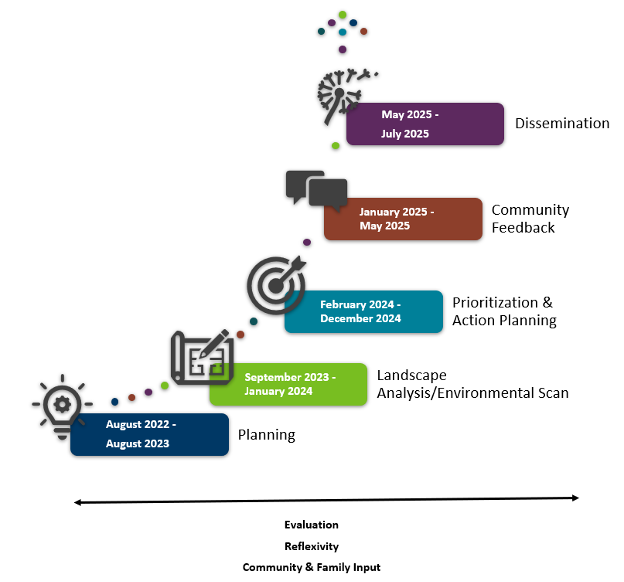
During phase one (Planning), MDH/Title V staff developed the overall needs assessment process and timeline, drafted initial materials that will be finalized and used across the other four phases – including guiding frameworks, analysis templates, and recruitment materials – and formed the internal working group. A list of the internal working group members can be found here: Needs Assessment Leadership Structure.
During phase two (Landscape Analysis/Environmental Scan), MDH/Title V staff collected and analyzed over 160 documents from programs across the state – including community health improvement plans, programmatic needs assessments, organizational strategic plans, and others – with the aim to gather information on the current landscape of maternal and child health needs across the state. Many of these efforts summarized in the documents were conducted in partnership with representation from communities across Minnesota.
An external steering committee was developed through an application process to help guide phases three through five of the 2025 needs assessment process, including codeveloping the Title V priorities, strategies, activities, and measures. Members were both external and internal stakeholders, made up of representatives from local public health, state agencies, health systems, and community/family members, with expertise across the six Title V population domains: infant/perinatal health, child health, adolescent health, children and youth with special health needs, women/maternal health, and cross-cutting/systems building.
A summary of phase two can be found here: Landscape Analysis Summary.
A list of the steering committee members can be found here: Needs Assessment Leadership Structure.
During phase three (Prioritization and Action Planning), findings from the landscape analysis in phase two will be used by MDH/Title V staff, the internal working group, and the steering committee to develop a minimum of five priorities - at least one per each of the focus populations listed above, strategies to address each priority, specific activities within each strategy, and measures to monitor progress and change for each priority selected. During this phase, Title V staff will conduct listening sessions and a feedback survey with staff across MDH, as well as with the 52 community health boards in Minnesota.
The 2026-2030 Title V State Action Plan (PDF) was developed through extensive data collection, review, and analysis which included:
- review of over 160 initiative documents from across the state of Minnesota – including local public health community health assessments
- a survey and listening sessions with Minnesota Department of Health Child and Family Health Division staff
- a survey and listening sessions with Minnesota’s local public health agencies
- a survey with Title V community partners in Minnesota.
- This process was conducted in partnership with and guidance from:
- a Title V internal working group from the Minnesota Department of Health Child and Family Health Division
- a Title V external steering committee made up of representatives from local public health, state agencies, health systems, community organizations, and community and family representatives
- the Minnesota Maternal and Child Health Advisory Committee.
During phase four (Public Feedback), MDH/Title V staff, the internal working group, and the steering committee sought feedback from community members across Minnesota about the drafted priorities, strategies, activities, and measures through community listening sessions and a feedback survey.
During phase five (Dissemination), MDH/Title V staff, the internal working group, and the steering committee will integrate community input from phase four to develop written reflections on the needs assessment processes, findings, and plan for next steps, as well as other formats to disseminate back to Minnesota’s communities. More information will be provided here as this phase progresses.
How to stay involved
The next needs assessment is slated to begin in 2027 and be completed in 2030.
Contact Elizabeth Taylor-Schiro, elizabeth.taylor-schiro@state.mn.us, if you have any questions about the needs assessment and action plan process.
Resources
- Title V Overview (Association of Maternal & Child Health Programs – AMCHP)
- Title V State Application/Annual Report (HRSA – Maternal and Child Health)