
Frequently Asked Questions About LPH Act Annual Reporting
Last updated: 27 April 2026
If you have questions not answered below, please contact us.
To jump to a question, click on the section heading and scroll down to the question you're looking for.
General questions
- When is reporting due?
- Do I report on behalf of my county or my community health board?
- Where can I find resources to help gather my data?
- What does MDH do with all of this data?
- How do I update my community health board’s contact information?
REDCap questions
- Where is my REDCap account?
- Why can't I log into REDCap?
- Will my REDCap account still lapse if I don’t log in?
- How do I navigate REDCap?
- I can't see this year's forms, where I actually enter my data. Where did they go?
- Can I print the REDCap forms to use as templates to gather data?
- How do I access past years' data in REDCap?
- Can more than one person enter data into the same REDCap form at the same time?
- Will REDCap show me reporting errors?
- How will MDH know if I'm done reporting? Can I use the incomplete-complete indicators at the bottom of each form?
- Where can I get a copy of the data I entered? Can I download and print my data?
- Why does REDCap seem to have more questions when I print out the forms than when I look at the forms on screen?
Expenditures and workforce questions
- What's changing for this reporting on expenditures and workforce?
- When is expenditures and workforce reporting due?
- Where can I find resources to help gather my expenditure and workforce data?
- What is validation?
Related: Will REDCap show me reporting errors?
Questions specific to expenditures
- Does my community health board submit a budget during LPH Act annual reporting?
- Where can I find the current community health board awards for the LPH and FPHR Grants?
- Do I report on what my community health board was awarded or what it actually spent?
- Can funds other than local funds be used for either the LPH Grant or FPHR Grant match?
- My community health board had revenues that exceeded expenditures. Is this captured in annual reporting?
- I invoiced for a reporting year expenditure but did not receive reimbursement during the reporting year. Do I report this as an expenditure?
- Where should I put specific funds and FTEs for programs like SHIP, Early Hearing Detecting Intervention, and other topics?
Questions specific to workforce
- Where should we categorize AmeriCorps staff?
- How should our community health board report benefits such as paid time off?
- For reporting number of staff, we had two staff during the year filling a single position at different times. Do we report both staff or just one?
- If someone left partway through the year, should I only include the portion of the FTE that was actually filled during the year?
Performance measures questions
- What's new for this reporting period in LPH Act performance measures?
- What should be considered when determining our community health board's capacity to meet the measure?
- Our community health board (CHB) includes multiple counties, and individual counties within the CHB have different levels at which they meet the measures at different levels. How do we report this variation as a CHB?
- Why do community health boards need to report on measures around surveillance (2.1.1) and lab access (2.1.3) if MDH provides the service to the health department?
- How do community health boards report on measures related to surveillance (2.1.1) and lab access (2.1.3) if MDH provides that service?
Frequently asked questions related to LPH Act annual reporting shift
The following questions are about the LPH Act annual reporting shift, which will begin in 2026 (reported in March 2027).
- What types of activities are considered "foundational"?
- What is meant by "community-specific"?
- Is there guidance on if the activities in our current funding are foundational or community-specific?
- How do we determine if an activity is a capability or area?
- How do we split time if it falls under multiple responsibilities?
- In the staffing report, will reporting align with the FPHR Framework by FTE and funding source as done in current annual reporting?
- How would workforce and expenditures related to Family Home Visiting be reported?
- Is there a list of activities that are federally- or state-mandated?
- How do we determine what area an activity fits under? For example, would childhood nutrition fit under maternal, child, and family health or chronic disease and injury prevention?
General questions
1. When is reporting due?
March 31. Each year, Local Public Health (LPH) Act annual reporting is open from mid-February through March 31.
2. Do I report on behalf of my county or my community health board?
LPH Act annual reporting occurs at the community health board level.
MDH recommends using instructions and guidance to gather your data from each county or local health department (if your community health board has more than one county) and then use that information to convey what’s happening within the community health board as a whole.
3. Where can I find resources to help gather my data?
Use the instructions and guidance to gather your data and walk you through each question.
4. What does MDH do with all of this data?
This data is used to track trends over time and is essential for advocacy and partnership discussions at both local and state levels. Local Public Health Association uses the data to inform their legislative fact sheet and MDH uses the data in bi-annual legislative reports. It also informs how the MDH Center for Public Health Practice supports local public health in its efforts.
MDH subject matter experts in different divisions outside of the Center for Public Health Practice also use data to inform their own training and technical assistance.
Each fall, MDH summarizes the previous year's finance and staffing data.
- For summaries of past years' data, visit: Past Data: LPH Act Annual Reporting.
- Please contact your CHS administrator for your community health board's own past reports on performance measures.
5. How do I update my community health board’s contact information?
Learn more: Community health board contact information.
MDH asked CHS administrators for the names of staff who will enter data into REDCap. If you have any questions about your REDCap account, please email Ghazaleh.dadres@state.mn.us.
- If you’re new to REDCap, you will not get an email from REDCap about your username and password until LPH Act annual reporting opens.
- If you already have a REDCap account, you’ll be able to log in to REDCap, but you won’t see the current year's reporting forms until LPH Act annual reporting officially opens.
7. Why can't I log into REDCap?
If you are experiencing problems logging in, please first try logging out, clearing your internet browser cache, and logging back in. Remember: your REDCap username does not include the @ symbol.
If this does not work, please send a message to health.ophp@state.mn.us describing the problem and including a screenshot of your error message. MDH will respond as promptly as possible.
Find more REDCap help at: Help with REDCap for LPH Act annual reporting.
8. Will my REDCap account still lapse if I don’t log in?
Yes; if you do not continue to use your account for 180 days, your account will go dormant. If that happens, please email ghazaleh.dadres@state.mn.us.
Tutorials and guides for REDCap are available online at Help with REDCap for LPH Act annual reporting.
10. I can't see this year's forms, where I actually enter my data. Where did they go?
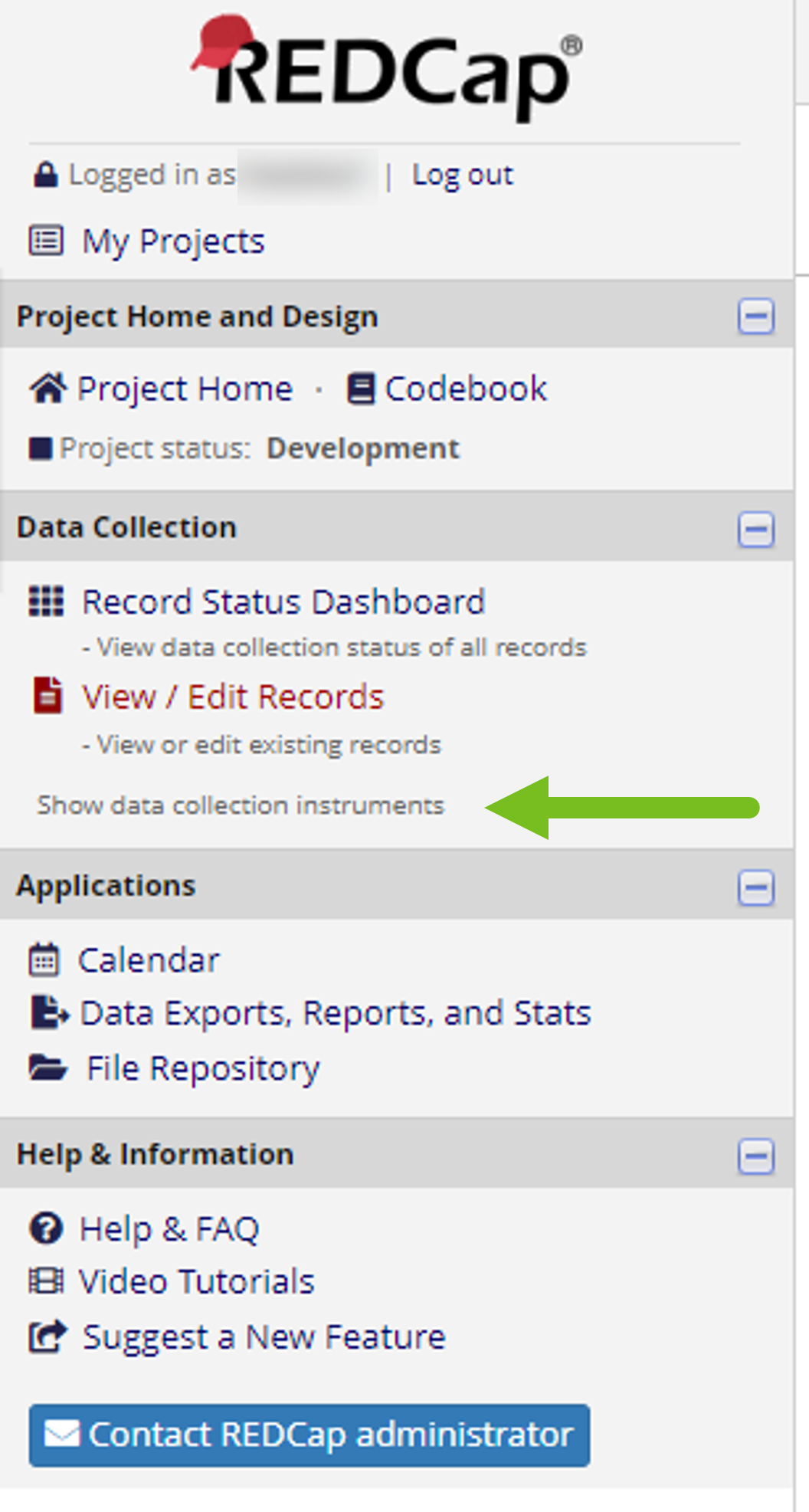
If you can't see this year's forms after logging into REDCap and choosing this year's project, look for small text on the left side of the screen, under "Data Collection," that says "Show data collection instruments." Click on "Show data collection instruments" to view this year's forms.
11. Can I print the REDCap forms to use as templates to gather data?
You certainly can, but you might have an easier time using the instructions and guidance for each module to gather your data. There is guidance to walk you through each module.
12. How do I access past years' data in REDCap?
If you need past years’ LPH Act annual reporting data and cannot access past years’ projects in REDCap, please email health.ophp@state.mn.us.
13. Can more than one person enter data into the same REDCap form at the same time?
Yes. More than one person can enter data into the same form because REDCap allows individuals to log in under their own accounts. Be sure to save your data early and often.
14. Will REDCap show me reporting errors?
If there are errors in your data entry for the finance/staffing module, REDCap will let you know as you enter data. MDH will review data after the LPH Act annual reporting closes.
If MDH continues to see any errors after you have submitted your data, MDH will contact you to follow up.
15. How will MDH know if I'm done reporting? Can I use the incomplete-complete indicators at the bottom of each form?
You let us know you have completed reporting via the REDCap validation form; this is the only way to complete reporting.
CHS administrators must complete validation when staff have finished entering all data.
At the bottom of each form, there is a place to mark for your own reference whether you've completed a form or not, which you can use to track your own progress, but MDH does not use these indicators to check for completion. CHS administrators must still complete validation. (You may see these complete/incomplete selections populate red-yellow-green indicators on your forms in the left-hand navigation pane; again, these are for your own internal reference only, and MDH does not use them to track progress.)
16. Where can I get a copy of the data I entered? Can I download and print my data?
After using the appropriate guidance or instructions to gather data (see: LPH Act annual reporting instructions), you can use the document as a reference for the data you entered.
You can also obtain a copy of your data from REDCap.
If you need past years’ LPH Act annual reporting data and cannot access past years’ projects in REDCap, please email health.ophp@state.mn.us.
17. Why does REDCap seem to have more questions when I print out the forms than when I look at the forms on screen?
The PDF has slightly more fields than the on-screen REDCap form because some questions have branching logic and are only "viewable" (and so answerable) if you choose a specific prior answer that pops open that question.
Expenditures and workforce questions
18. What's changing for this reporting on expenditures and workforce?
Beginning in calendar year 2026 (reported by March 31, 2027), all community health boards will need to report workforce and expenditures in a new way, in alignment with the FPHR framework. This means for each area (communicable disease control, chronic disease and injury prevention, etc.) expenditures and FTE (filled and contracted) should be categorized as either foundational or community-specific.
19. When is expenditure and workforce reporting due?
Complete all expenditure and workforce modules by March 31.
Remember: CHS administrators must complete validation when staff have finished entering all data. Be sure to allow time for your CHS administrator to complete validation and correct any errors.
20. Where can I find resources to help gather my expenditure and workforce data?
Visit: LPH Act Annual Reporting Instructions. This webpage outlines the changes beginning for calendar year 2026 and includes resources to help community health boards get ready.
Learn more about the changes: Aligning LPH Act Annual Reporting with Foundational Public Health Responsibilities.
21. What is validation?
Validation is the name given to the review of data to verify accuracy and completeness.
CHS administrators must submit the final validation form for expenditures and workforce reporting. This lets MDH know you have fixed errors (if applicable) and that you’re done with these forms.
Learn more: Validation.
Related: Will REDCap show me reporting errors?
Questions specific to expenditures
22. Does my community health board submit a budget during LPH Act Annual Reporting?
No. You do not need to submit a budget for the year ahead.
23. Where can I find the current community health board awards for the Local Public Health Grant and the Foundational Public Health Responsibilities (FPHR) Grant?
Visit: Funding and the Local Public Health Grant and Funding for FPHR Grant.
24. Do I report on what my community health board was awarded or what it actually spent?
You should report on what your community health board spent, regardless of the original award amount.
25. Can funds other than local funds be used for either the Local Public Health grant or Foundational Public Health Responsibility grant match?
The purpose of the match is to demonstrate local commitment to investing in public health. Generally, health departments include local sources of revenue first to demonstrate this commitment (levy, reimbursements, fees, other local funds).
Statute provides guidance for what constitutes eligible funds, which includes funding provided from an entities other than the federal government (see below). Any state funds used will need to be specifically identified in the Breakdown form. Reminder, the Local Public Health Grant cannot be used for the Foundational Public Health Grant match and versa.
Sec. 145A.131 MN Statutes, Subd.2 (b) Eligible funds must be used to meet match requirements. Eligible funds include funds from local property taxes, reimbursements from third parties, fees, other local funds, and donations or nonfederal grants that are used for community health services described in section 145A.02, subdivision 6
26. My community health board had revenues that exceeded expenditures. Is this captured in annual reporting?
No, there is not a place in annual reporting to reflect excess revenue. Annual reporting reflects expenditures during a point in time (January 1 through December 31) and is designed to answer system spending-pattern questions, it is not designed to answer budget management or budget balancing questions.
27. I invoiced for a reporting year expenditure but did not receive reimbursement during the reporting year. Do I report this as an expenditure?
Yes, include expenditures that were invoiced in the reporting year, regardless of if funds were received. Reporting for the year should reflect what was spent/invoiced.
28. Where should I put specific funds and FTEs for programs like SHIP, Early Hearing Detecting Intervention, and other topics?
Consult the instructions: LPH Act Annual Reporting Instructions. The appendix includes a list of common grants to community health boards and what funding sources to put them under.
Questions specific to workforce
29. Where should we categorize AmeriCorps staff?
If you contracted with AmeriCorps for staff, you would likely categorize them in Staffing Section II. Number of Contracted FTEs within the role and area of responsibility in which they’re working.
30. How should our community health board report benefits such as paid time off?
There is not a special category for paid time off. It is recommended that you allocate proportionately across their typical work. If this is not feasible, determine how your community health board is going to report paid time off and do it consistently each year.
31. For reporting number of staff, we had two staff during the year filling a single position at different times. Do we report both staff or just one?
For reporting the number of staff, both staff should be included. This data is used in the analysis of workforce race/ethnicity and reflects the time period Jan. 1 through Dec. 31.
32. If someone left partway through the year, should I only include the portion of the FTE that was actually filled during the year?
Yes. "Filled FTEs" reflects the amount of staffing actually filled during the reporting period, not just the budgeted position amount. So, if someone left partway through the year, only the portion of the FTE that was actually filled would be counted.
For example:
- A 1.0 FTE employee worked for 6 months and then the position was vacant for 6 months → reported as approximately 0.5 FTE for the first year.
- A 0.8 FTE employee left after 3 months → approximately 0.2 filled FTE for the year (0.8x3/12).
Performance measures questions
33. What's new for this reporting period in LPH Act performance measures?
There are no changes to reporting performance measures. All community health boards will continue to self-assess capacity (on a scale from fully met to cannot meet) to meet a set of 46 national measures. See the recommendations report appendix A for the full list of measures: Performance Measurement and Performance-Related Accountability Requirements Approved Recommendations (PDF)
34. What should be considered when determining our community health board's capacity to meet the measure?
The instructions include guidance related to each measure, including the requirements and elements from PHAB version 2022. Review each element and consider how well the work was carried out. There is guidance for each measure to help determine which response option is most appropriate for your community health board.
35. Our community health board (CHB) includes multiple counties. Individual counties within the CHB have different capacity to meet the measures. How do we report this variation as a CHB?
A multi-county community health board should report on the lowest capacity of its individual health departments to ensure capacity gaps are not masked by averages or reporting to the highest capacity Review the guidance and instructions for more information and an example. CHBs are encouraged to examine variation in capacity of member health departments and identify opportunities for system improvements.
36. Why do community health boards need to report on measures around surveillance (2.1.1) and lab access (2.1.3) if MDH provides the service to the health department?
SCHSAC’s Performance Measurement Workgroup recommended reporting on these measures because of the importance of having clear, documented protocols, procedures, and assurances related to surveillance and detection of disease, even if another entity is providing that service.
37. How do community health boards report on measures related to surveillance (2.1.1) and lab access (2.1.3) if MDH provides that service?
See Performance Measurement Instructions for CY2024 LPH Act Annual Reporting (PDF) for more guidance. If another organization provides a service, a health department should have an understanding about how the providing entity performs surveillance, which could include, for example, an MOU or shared policy/procedure. Standards-Measures-Initial-Accreditation-Version-2022 (PDF) (2.1.1 begins on page 58, 2.1.3 on page 66)
If after reading the guidance and considering your current status you are still unsure, select the “Unsure how to respond” option which was added to measures 2.1.1 and 2.1.3.
Use your best judgment based on the guidance, and documentation you currently have. It is okay if your CHB reports “minimally,” “cannot meet,” or “unsure how to respond.” The goal is to identify areas for improvement, including how CHBs and MDH work together.
Frequently asked questions related to LPH Act annual reporting shift
The following questions and answers are intended to help guide community health boards as they shift to organize Local Public Health (LPH) Act annual reporting on workforce and expenditures around the Foundational Public Health Responsibility Framework. This new reporting structure will begin in calendar year 2026 and will be reported in March 2027. The responses to the questions are based on what is currently known. These responses will be updated or fine-tuned as more information is available.
38. What types of activities are considered "foundational"?
On this webpage, several resources are available to describe what is foundational in Minnesota and criteria distinguishing foundational work: Definitions, Criteria, and Standards for Fulfillment of Foundational Public Health Responsibilities - MN Dept. of Health
For more description of foundational work in capabilities and areas, review this webinar: Foundational Public Health Responsibilities Overview - MN Dept. of Health and use this guide: Foundational Public Health Responsibilities: National Framework, Minnesota Activities (PDF)
39. What is meant by “community-specific”?
Community-specific represents the unique needs of your community or jurisdiction that are outside of what is considered foundational. They are still very important, but unique to a given community or jurisdiction. While not an exhaustive list, for examples distinguishing between foundational and community-specific, go to p. 3 of A New Framework for Governmental Public Health in Minnesota (PDF).
40. Is there guidance on what activities in our current funding are foundational or community-specific?
Activities implemented by the funding sources that support governmental public health vary from jurisdiction to jurisdiction. Look to grant agreement duties and definitions of foundational to determine what activities implemented under specific funding sources are best categorized as foundational or community-specific.
The FPHR grant is intended for foundational work, so there should be no funding from the FPHR grant for community-specific activities unless the community health board can demonstrate they fulfill the standards for foundational public health responsibilities, and their request was granted to use the grant for community-specific priorities identified in their community health assessment and improvement plan.
41. How do we determine if an activity is a capability or area?
Capabilities are cross-cutting skills, abilities, and knowledge needed in any governmental public health system to provide basic public health protections. Capabilities cut across multiple programs. Areas are topic-specific programs and activities.
To determine if the work fits best as a capability or area, refer to this guide: Definitions, Criteria, and Standards for Fulfillment of Foundational Public Health Responsibilities.
For example, developing a robust communications plan that includes policies and practices to support the implementation of social media, health education and risk communications, and developing relationships with local media outlets would fall under the capability of
communication. Utilizing communication messages and channels in the communications plan to support messaging in a specific program would likely fall under the area the program is related to.
42. How do we split time if it falls under multiple responsibilities?
In the case of an activity that aligns with more than one responsibility, it is up to the community health board to determine how the time is allocated. The time spent should be divided up, not counted double.
43. In the staffing report, will reporting align with the FPHR framework by FTE and funding source as done in current annual reporting?
Yes.
44. How would staff and expenditures related to Family Home Visiting be reported?
Providing home visiting services to at-risk families is community-specific. While vital to communities, governmental public health is not the only provider of home visiting services across the state. Even if governmental public health is the only provider in your community, this is a unique protection for your community. There may be activities related to family home visiting that are foundational. For example, monitoring data and emerging trends related to maternal and child health in the community— such as infant mortality rates, rates of disparity in birth outcomes, infant mortality and child health, and other indicators of the health of mothers and children, would be considered foundational.
45. Is there a list of activities that are federally- or state-mandated?
Not at this time.
46. How do we determine what area an activity fits under? For example, would childhood nutrition fit under maternal, child, and family health or chronic disease and injury prevention?
Consider the overall goal of the activity. Refer to this guide to determine the best fit: Definitions, Criteria, and Standards for Fulfillment of Foundational Public Health Responsibilities.
Once you make a decision, be consistent in reporting