
Secondary menu

  • About Us
  • News & Stories
  • Translated Materials
Minnesota Department of Health logo
  • Data, Statistics, and Legislation

    Data, Statistics, and Legislation

    Statistical reports, health economics, policy, and legislation.
    Data, Statistics, and Legislation
    • Community Health
    • Diseases and Conditions
    • Environmental Health
    • Health Behaviors and Risk Factors
    • Health Care Cost and Quality
    • Reporting and Exchanging Data
    • Legislation and Policy
  • Diseases and Conditions

    Diseases and Conditions

    A-Z disease listing, diseases and conditions by type.
    Diseases and Conditions
  • Health Care Facilities, Providers, and Insurance

    Health Care Facilities and Providers

    Directories of facilities, professional certifications, health insurance and patient safety.
    Health Care Facilities and Providers
    • Facility Certification, Regulation and Licensing
    • Insurance
    • Health Information Technology
    • Provider Certifications, Licenses, Registrations and Rosters
    • Patient Health and Safety
    • Health Care Homes
    • Notices Related to Health Records
    • Rural Health and Primary Care
    • Trauma System
  • Healthy Communities, Environments, and Workplaces

    Healthy Communities, Environments, and Workplaces

    Indoor air and drinking water quality, community prevention and emergency preparedness.
    Healthy Communities, Environments, and Workplaces
    • Community Wellness and Health Equity
    • Healthy Schools and Child Care
    • Healthy Businesses and Workplaces
    • Local Public Health
    • Environments and Your Health
    • Safety and Prevention
    • Emergency Preparedness and Response
    • Equitable Health Care Task Force
    • Transforming the Public Health System in Minnesota
  • Individual and Family Health

    Individual and Family Health

    Birth records, immunizations, nutrition and physical activity.
    Individual and Family Health
    • Vital Records and Certificates
    • Disabilities and Special Health Needs
    • Disease Prevention and Symptom Management
    • Healthy Aging
    • Healthy Children, Youth and Adolescents
    • Mental Health and Well-being
    • Reproductive Rights and Protections in Minnesota
    • Women and Infants
MDH Logo

Breadcrumb

  1. Home
  2. Healthy Communities, Environment and Workplaces
  3. Physical Activity
Topic Menu

Physical Activity

  • Physical Activity Home
  • Basics
  • Active Schools Minnesota
  • Active Recess Videos
  • Active Transportation
  • Safe Routes to School
  • Walk and Bike Friendly Communities
  • Walkable Community Workshops
  • Resources

Related Sites

  • Managing Chronic Conditions during COVID-19
  • SHIP
  • TV, Screen Time and Health

Physical Activity

  • Physical Activity Home
  • Basics
  • Active Schools Minnesota
  • Active Recess Videos
  • Active Transportation
  • Safe Routes to School
  • Walk and Bike Friendly Communities
  • Walkable Community Workshops
  • Resources

Related Sites

  • Managing Chronic Conditions during COVID-19
  • SHIP
  • TV, Screen Time and Health
Contact Info
Office of Statewide Health Improvement Initiatives
health.activeliving@state.mn.us

Contact Info

Office of Statewide Health Improvement Initiatives
health.activeliving@state.mn.us

Moving Matters Toolkit

An Implementation Toolkit for Schools

Active Schools MinnesotaThe Moving Matters School Implementation Toolkit, an initiative of the Minnesota Department of Education and Minnesota Department of Health, helps schools provide students with quality physical education and activity.

  • Download the Moving Matters Toolkit (PDF)

These strategies have been successfully implemented in many schools across Minnesota and the nation and are based on best practices from the American Alliance for Health, Physical Education, Recreation and Dance's Comprehensive School Physical Activity Program, along with Let's Move! Active Schools campaign.

The Issue: Children Have Stopped Moving
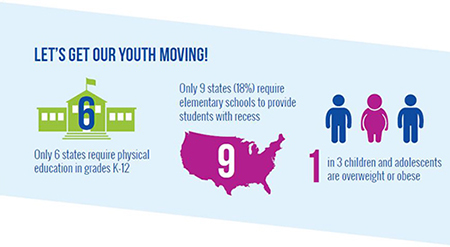
only six states require PE in K-12, only 9 states require recess in elementary schools, 1 in 3 children are overweight or obese

Both at home and school, children have become increasingly sedentary over the past few decades: 41 percent of students walked or biked to school in 1969 compared to only 13 percent by 2001.

At home, active play has been replaced by the TV and computer games while at school, tight budgets and a focus on core academic subjects and high-stakes testing have resulted in a decline in physical education and activity.

Regular physical activity is a key preventative measure in the development of chronic illnesses and diseases, including mental health problems – conditions that impact student attendance and being "on task." Clearly, there is a role for schools to play in turning the tide on this alarming reduction in children’s physical activity. With youth spending a minimum of 30 to 40 hours at school each week (6 to 8 hours a day), there are multiple opportunities for schools to provide more physical activity to students.

Learn More

Thanks to the Statewide Health Improvement Partnership, Minnesota schools are working to increase physical activity within the instructional setting, building a foundation for lifelong physical activity. Active classroom breaks, physical education and active recess all mean kids not only are healthier, but do better in the classroom. Learn more about SHIP.

Tags
  • physical activity
Last Updated: 09/06/2024
  • Facebook
  • X
  • Instagram
  • LinkedIn
  • Youtube

About MDH

  • About Us
  • Grants and Loans
  • Advisory Committees

Legal & Accessibility

  • Privacy Policy
  • Equal Opportunity
  • Feedback Form

Careers at MDH

This is an official website of the State of Minnesota. Visit Minnesota.gov for more information.