Minnesota Department of Health logo
  • Main navigation

    • Home
    • Data, Statistics, and Legislation
    • Diseases and Conditions
    • Health Care Facilities, Providers, and Insurance
    • Healthy Communities, Environment, and Workplaces
    • Individual and Family Health
    • About Us
    • News and Announcements
    • Translated Materials

Main navigation mobile

  • Data, Statistics, and Legislation
  • Diseases and Conditions
  • Health Care Facilities, Providers, and Insurance
  • Healthy Communities, Environment, and Workplaces
  • Individual and Family Health
  • About Us
  • News and Announcements
  • Translated Materials
MDH Logo

Breadcrumb

  1. Home
  2. Healthy Communities, Environment and Workplaces
Topic Menu

Drug Overdose Prevention

  • Drug Overdose Prevention Home
  • Data
  • Overdose Education
  • Harm Reduction
  • Minnesota Overdose Response
  • Treatment and Recovery
  • Overdose Outreach and Engagement
  • Prevention

Related Topics

  • Alcohol and Other Drugs
  • Human Trafficking
  • Injury and Violence Prevention Home
  • Occupational Health
  • Sexual Violence Prevention
  • Suicide Prevention
  • Traumatic Brain and Spinal Cord Injuries

Drug Overdose Prevention

  • Drug Overdose Prevention Home
  • Data
  • Overdose Education
  • Harm Reduction
  • Minnesota Overdose Response
  • Treatment and Recovery
  • Overdose Outreach and Engagement
  • Prevention

Related Topics

  • Alcohol and Other Drugs
  • Human Trafficking
  • Injury and Violence Prevention Home
  • Occupational Health
  • Sexual Violence Prevention
  • Suicide Prevention
  • Traumatic Brain and Spinal Cord Injuries
Contact Info
Injury and Violence Prevention Section
health.injuryprevention@state.mn.us

Contact Info

Injury and Violence Prevention Section
health.injuryprevention@state.mn.us

Medications for Opioid Use Disorder (MOUD)

Opioid use disorder (OUD) is a medical condition with an effective available treatment. Medications for Opioid Use Disorder (MOUD) help people by easing withdrawal symptoms, reducing cravings, and supporting stability. MOUD is the gold standard of care for OUD, and it significantly improves the success of long-term recovery.

Everyone deserves compassionate, evidence-based treatment, and MOUD is one of the most powerful tools we have to help people heal.

FDA-approved MOUDs

FDA-approved MOUDs include methadone, buprenorphine, and naltrexone, with the strongest evidence supporting buprenorphine and methadone.
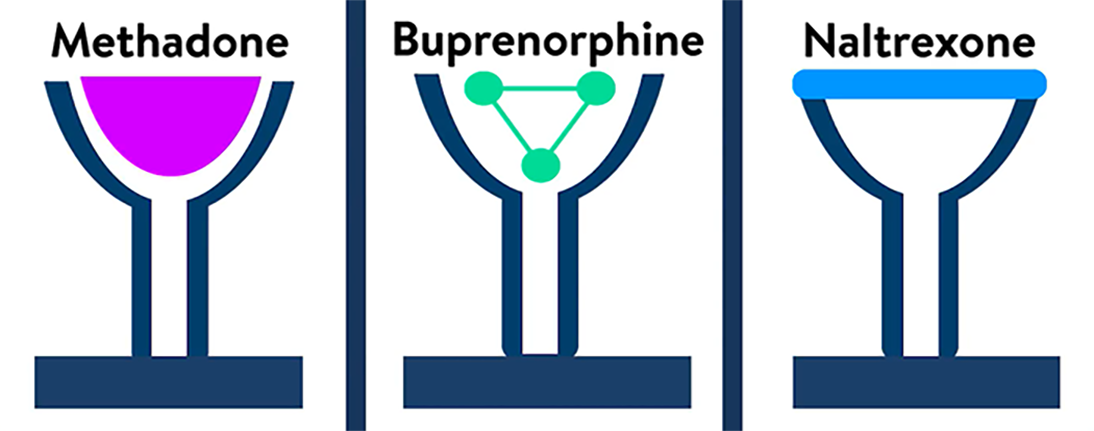
Diagram showing the 3 types of available medications for opioid use disorder: methadone, buprenorphine, and naltrexone.

Buprenorphine

  • Partially activates opioid receptors to prevent withdrawal symptoms and reduce cravings (partial opioid agonist).
  • Daily (oral), weekly (injectable), and monthly (injectable) formulations are available.
  • Can be prescribed in any clinical setting by any clinician with a standard DEA Schedule III registration.

Methadone

  • Fully activates opioid receptors at a controlled, stable level to prevent withdrawal symptoms and reduce cravings (full opioid agonist).
  • Often requires daily in-person visits at the beginning of treatment until take-home doses are permitted.
  • Can only be provided through federally certified Opioid Treatment Programs (OTPs, also known as methadone clinics).

Naltrexone

  • Completely blocks opioid receptors to prevent opioids from activating them (opioid antagonist).
  • Does not relieve withdrawal symptoms or cravings but prevents the effects of opioids if they are used.
  • Requires a period of complete opioid abstinence before starting treatment.
  • Can be prescribed by any clinician with a license to prescribe medications.

How MOUD works

When opioids like fentanyl enter the brain, they bind to receptors that activate the body’s reward system, slowing down internal organs and providing intoxicating effects.

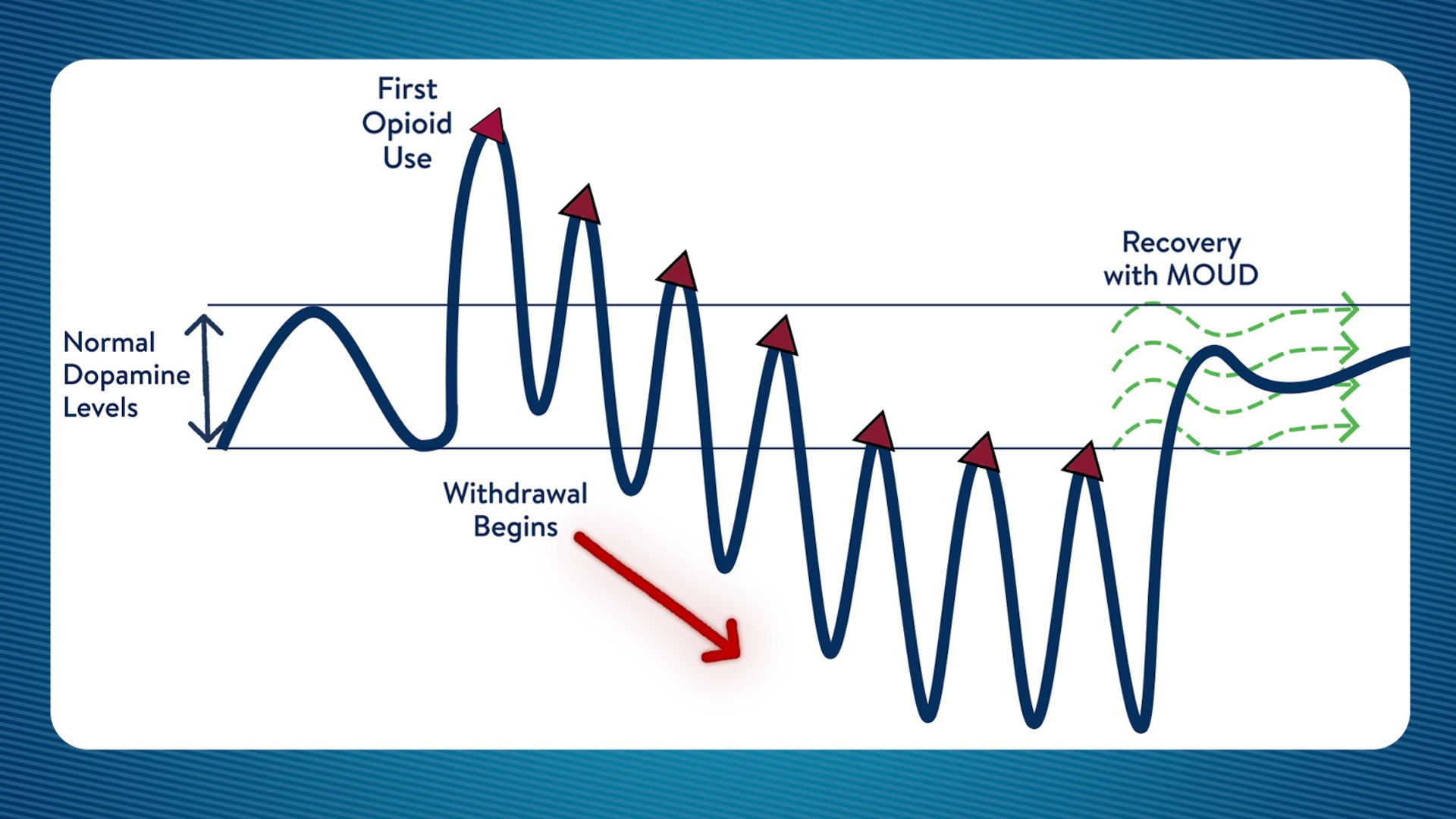
Repeatedly using opioids wears down these receptors and causes the brain to build up an opioid tolerance. This means more opioids are needed each time to prevent the body’s survival system from triggering painful withdrawal symptoms – like nausea, fever, and extreme body aches – that can make it impossible to function in daily life.

Chart showing how dopamine levels in the brain are affected by withdrawal.

Normal dopamine levels in the brain vary throughout the day. Opioid use raises these levels significantly, until withdrawal symptoms throw this cycle out of balance. With MOUD, patients can get their dopamine levels back into the normal range and focus on recovery. 

Buprenorphine works by attaching to the brain’s opioid receptors and partially activating them. This stabilizes these receptors just enough to relieve withdrawal symptoms and reduce cravings, without producing the intoxicating effects associated with full opioids. By providing this steady, controlled activation, buprenorphine helps people feel well enough to focus on recovery and succeed in daily life.

Low barrier MOUD access

Despite MOUD being a highly effective treatment, many people in Minnesota still face barriers to accessing it. In response, hospitals, emergency departments, clinics, emergency medical services (EMS), and other nontraditional sites across the state are implementing innovative “low barrier” approaches that remove unnecessary obstacles and prioritize quick, easy, and respectful access to MOUD for anyone who needs it.

Low barrier strategies include:

  • Same-Day Access: Offer medication on the first visit whenever possible.
  • Flexible Delivery: Provide care in shelters, walk-in clinics, syringe services programs, emergency departments, outreach vans, pharmacies, and via telehealth.
  • Person-Centered: Support people who use drugs without requiring abstinence and accept relapse as a part of the recovery journey.
  • Trauma-Informed: Build trust through dignity, empathy, and culturally responsive care.
  • Retention over Perfection: Prioritize staying connected with patients over enforcing strict compliance with appointments or protocols.

MDH-funded MOUD programs

  • Emergency Medical Services (EMS): With a combination of state and federal funding, MDH has supported MN Bridge and multiple EMS agencies in implementing EMS-initiated buprenorphine. EMS is uniquely positioned to deliver rapid access to evidence-based care and linkage to ongoing treatment directly in the community. More information on EMS-initiated buprenorphine is available on the MN Bridge webpage.
  • Primary Care Clinics: Tackling Overdose with Networks (TOWN) is a state-funded clinic-based program that works directly with primary care providers to increase MOUD availability and expand the number of qualified prescribers across Minnesota.
  • Emergency Departments: With federal funding, MDH helped launch a network of five emergency departments working to increase MOUD access and expand the implementation of patient navigators in emergency departments.
    • Pilot sites include: Essentia Health – Duluth, Sanford Health – Bemidji, CentraCare – St. Cloud, Abbot Northwestern Hospital – Minneapolis, and Hennepin Healthcare – Minneapolis.
    • As of October 2025, Minnesota Health Care Programs (MHCP) will cover G2213 as an add-on code to support reimbursement for the initiation of medication for opioid use disorder (MOUD) in emergency departments.

Resources for providers

  • MNBridge.org is an EMS-led website designed to support providers in initiating MOUD in the field by offering protocols, training materials, clinical guidance, and implementation tools.
  • Get training materials and resources on MOUD: Home - Providers Clinical Support System-Medications for Opioid Use Disorders (PCSS-MOUD)
  • Buprenorphine Protocols from California Bridge: On-Shift - Bridge to Treatment
  • Call the National Clinician Consultation Center - Substance Use Warmline for free, confidential, clinician-to-clinician phone consultation on evidence-based substance use evaluation and management.
    • Available Monday – Friday, 8 a.m. to 7 p.m. CT to any provider in need of specialty addiction medicine consultation. Voicemail is open 24 hours a day, seven days a week. (855) 300-3595.
  • Locate certified practitioners who treat substance use disorder using SAMSHA’s Substance Use Treatment Locator.
  • NO PAIN MN seeks to help patients experiencing chronic pain find alternatives to opioids and narcotics for pain management. NO PAIN MN is a useful tool for patients and providers in locating treatment methods that are safe, reliable, and effective for managing and healing pain.
  • CDC’s Addiction Medicine Toolkit provides an overview of substance use disorders and the field of addiction medicine, including diagnosis and treatment of substance use disorders, linkage to care, methods to reduce stigma, and communication strategies that foster trust and help to build a collaborative patient relationship. Free continuing education (CE) credit is available.
  • CDC Clinical Practice Guidelines for Prescribing Opioids for Pain: These guidelines focus on prescribing opioids for treating chronic pain outside of active cancer treatment, palliative care, and end-of-life care.

Online trainings and continuing education

  • Minnesota Project ECHOs: ECHO participants engage in a virtual community with their peers where they share support, guidance and feedback. As a result, collective understanding of how to disseminate and implement best practices across diverse disciplines continuously improves and expands.
    • Project ECHO - Hennepin Healthcare
    • Stratis Health Opioid Addiction in Rural (SOAR) Project ECHO - Stratis Health
  • The California Bridge On Demand Training: The California Bridge Program, which works to provide access to MOUD in emergency departments, offers a host of evidence-based on demand trainings for providers and clinicians. Topic areas include clinical treatment, navigation to care, and harm reduction. MDs, DOs, PAs, and NPs can earn Continuing Medical Education (CME) credits through the Bridge Academy, which can be applied to the one-time DEA license renewal requirements. Nurses can use the Bridge Academy to watch trainings and earn CE Contact Hours.
  • CDC’s 2022 Clinical Practice Guideline for Prescribing Opioids for Pain: This CDC training highlights recommendations on MOUD implementation and provides example patient scenarios. Continuing education credits are available.

X-Waiver Removal

There is no longer a federal requirement for practitioners to submit a waiver to prescribe buprenorphine to treat OUD. Prescriptions for OUD, like all prescriptions, now only require a standard Drug Enforcement Agency (DEA) registration number. For more information visit SAMHSA’s Waiver Elimination webpage.

Tags
  • opioids
Last Updated: 12/16/2025

Get email updates


Minnesota Department of Health logo

Privacy Policy
Equal Opportunity
Translated Materials
Feedback Form
About MDH
Minnesota.gov
  • Facebook
  • Twitter
  • Linked In
  • Instagram
  • Youtube
Minnesota Department of Health Minnesota Department of health print search share facebook instagram linkedin twitter youtube