
Contact Info
August 2026 Grantee Spotlight
Dakota County
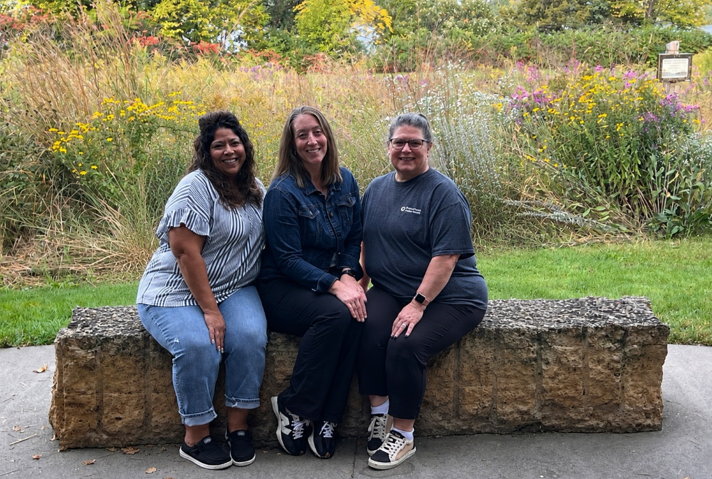
Dakota County's three supervisors: Rosanna Espinoza (left), Lisa Guck (middle), and Amy Mimm (right).
Dakota County was one of the first implementers of the Maternal Early Childhood Sustained Home-visiting (MECSH) model in Minnesota. The team attended the first few MECSH trainings hosted by the Minnesota Department of Health (MDH) in 2020 to fully transition their evidence-based practice to the model. Two of their MECSH supervisors, Amy Mimm and Lisa Guck, are not only overseeing the agency’s everyday implementation and practice of the model locally, but they also provide ongoing training support for the MECSH model at the state level. Dakota County’s investment into MECSH is apparent from both a local and statewide perspective.
Mimm and Guck work with a team of three other MECSH trainers to support all the training needs for the MECSH model in Minnesota. They were asked what inspired them to be MECSH trainers, how their experience as home visiting supervisors (and previously as home visitors) has impacted and guided their work as trainers, how being a trainer has impacted and guided their work as a MECSH supervisor, and lastly, what their favorite thing(s) are about this work.
Amy Mimm has a variety of experiences in maternal and child health, including children and youth with special healthcare needs, Follow Along Program, environmental lead exposure, families experiencing substance use disorder, and parental mood disorders. She has worked in family home visiting for 30 years. She began her career at the Metropolitan Visiting Nurse Agency and then transitioned to Dakota County, where she has been for the last 27 years. What Amy enjoys most about this work is the opportunity to meet home visitors from all corners of the state and experience their mutual yet unique passion for communities and the families they serve.
When asked what drew Mimm to wanting to be a MECSH trainer she said, “I worked in nursing education for a few years, so being a MECSH trainer ties my interest in education and training with family home visiting.” This passion for teaching is evident when Amy is training; she brings active reflection, engagement, guidance, and real-life practicality to her facilitation style. There is rarely a question or scenario that stumps her in this line of work!
Amy’s experiences as a supervisor and home visitor have impacted her work by prioritizing relationship-building with families, staff, and training participants. “I have also learned to be flexible and creative when things don’t go as planned,” said Mimm, and “[being a MECSH trainer] has helped me better understand the MECSH model so I can reinforce the ‘why and how’ of working in the MECSH model with staff.”
Lisa Guck has been a nurse for over 15 years, 10 of which have been spent working in public health. Prior to being a supervisor at Dakota County, Lisa worked for several years as a home visitor, partnering with pregnant people and families with children from birth through age three.
When reflecting on the impact of being a home visitor, Guck said, “I built trusting relationships with families, provided education and support related to pregnancy, child development, parenting, and health promotion, and connected families with community resources to address their unique needs. These experiences have given me a strong understanding of the importance of family-centered, strengths-based care and the impact that early intervention can have on improving outcomes for children and families.” Her experience as a home visitor and supervisor are apparent when she is facilitating trainings, which like Amy, result in real-life scenarios in her facilitation. Lisa shows up to train with excitement, joy for the work, and a vast amount of working knowledge of maternal and child health in Minnesota.
Lisa was initially drawn to the work of becoming a MECSH trainer because it would deepen her own understanding of the model and allow her to better support her team, therefore demonstrating her value of continuous growth in practice. “Becoming a trainer has challenged me to continually learn, reflect, and strengthen my own skills, which has also made me a more effective supervisor. I was also excited about the opportunity to connect with home visiting professionals across the state. Meeting new people, learning from their experiences, and sharing ideas has broadened my perspective and reinforced the importance of ongoing learning and collaboration,” shared Guck.
Having experience as a family home visitor and a home visiting supervisor has been foundational to Lisa’s work as a MECSH trainer. “As a home visitor, having directly worked with pregnant individuals and families with young children, I understand the realities of home visiting – the importance of building trusting relationships, meeting families where they are, adapting to each family’s unique circumstances, and using a strengths-based, family-centered approach.” As a MECSH trainer, Lisa pulls on her experiences “to make training practical, engaging and relevant by connecting principles of MECSH to real-world home visiting examples.” She feels it enhances her ability to provide coaching and reflective supervision to her staff, apply model principles in their day-to-day work, identify opportunities for learning, and foster critical thinking rather than just providing answers. Lisa expressed that “being both a trainer and supervisor allows me to create consistency between training and practice, helping home visitors feel confident and supported in delivering high-quality, family-centered services.”
Lastly, when asked what Lisa’s favorite part of this work is, she said “my favorite part of this work is seeing growth happen at every level. I enjoy supporting home visitors as they build confidence, strengthen their skills and grow in their practice, know that this ultimately impacts the families and children they serve.” She values the parallel process in home visiting; when home visitors feel supported and empowered, they are more readily able to do the same for families, resulting in strong relationships, healthy development, and positive outcomes for children in Minnesota.
MDH is incredibly lucky to have local staff, like Amy and Lisa, supporting the work of the MECSH model across Minnesota. Their lived experience as home visitors and supervisors enriches the model training, making them practically relatable and experts of the communities in which they live and serve.