
2026 Public Health Laboratory Newsroom
Meet the Scientist: Clinical Quality Assurance Officer Jacqueline “Jax” Benjamin
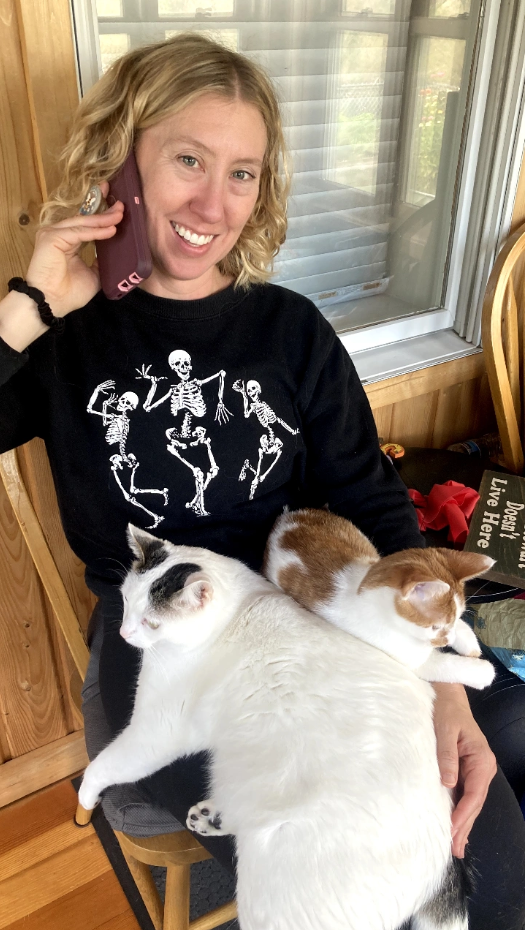 Jacqueline “Jax” Benjamin trained and worked for several years as a laboratory scientist. As she gained experience, she found that she especially enjoyed improving processes to make lab work more efficient and consistent. As the clinical quality assurance officer of the Minnesota Public Health Laboratory, she helps fellow scientists do their jobs better.
Starting in Lab Work
When Jax Benjamin was young, she dreamed of being a veterinarian. She also played cello and considered going into musical performance. In college at University of Wisconsin – River Falls, she expanded her focus to biotechnology, which encompasses a broad range of sciences.
Before Jax graduated from college, she had a job lined up at Memorial Blood Centers. The West Nile virus had just appeared in the United States, and the federal Food and Drug Administration (FDA) had mandated that all blood centers test for the virus. Jax immediately began work testing blood for West Nile virus, HIV, syphilis, hepatitis, and many other diseases.
The work was tightly regimented with a high volume of tests every day. There is no room for error in blood banking: A mistake could cost someone’s life. This need for a precise and reliable system proved fascinating for Jax.
Moving into Quality Assurance
In her 13 years at Memorial Blood Centers, Jax cross-trained in other areas, including quality assurance. She then took a job as an internal auditor at Memorial Blood Centers to learn more about the behind-the-scenes processes that made blood donation function. She learned how to screen donors, the relevant FDA regulations, the collections process, and much more.
One quality assurance project involved bringing on new software to improve the testing process. It was a complex project that had a large impact on Memorial Blood Centers’ work. Before a precise software-based system was mapped out and maintained by quality assurance, much of the operation relied on paper forms and staff remembering to take the necessary steps.
For example, before the software system, when things went wrong in the lab, employees would fill out paper forms that would be then passed around the organization. It was easy to lose the forms and difficult for management to track trends in the mistakes. After software was installed, employees could much more easily share information, and managers could quickly discover whether mistakes were becoming more common or less.
Over several years Jax worked her way up to a quality specialist position. She dealt with external auditors, including the FDA and the accrediting body AABB. She also learned how other blood centers operated. Jax sifted through the hundreds of ways the lab could fulfill regulations and get blood donations to hospitals, searching for the most elegant, inexpensive, and foolproof methods possible. It was especially rewarding when a staff member raved about a new process making their job easier.
Joining the Minnesota Public Health Laboratory
In 2019, Jax took a similar job, that of clinical quality assurance officer, at the Minnesota Public Health Laboratory. Her purview covers the clinical areas of the division: The Infectious Disease Laboratory, the Newborn Screening Program, and the parts of the Environmental Laboratory that deal with biological specimens.
However, soon after Jax was hired, the COVID-19 pandemic upended both the world and the lab. Because its scientists are uniquely capable of devising new testing procedures very quickly, the Minnesota Public Health Laboratory was the first lab in the state to test samples for evidence of COVID-19 infection. Jax was pressed into service helping process samples.
Once other public and private laboratories began handling COVID-19 testing, the volume of samples coming to the Minnesota Public Health Laboratory subsided. Jax could switch to adapting lab procedures to the restrictions of the pandemic. Largely this meant abandoning paper forms and establishing online systems.
Now Jax focuses on creating and maintaining processes to ensure lab scientists can conduct a wide range of tests in ways that produce reliable results and conform with all relevant regulations and standards. This requires an especially high level of skill and knowledge at the Minnesota Public Health Laboratory, which is on the cutting edge of clinical testing and often designs and validates new tests.
The Minnesota Public Health Laboratory is widely regarded as one of the leading public health laboratories in the United States. Recently its Infectious Disease Laboratory took a leadership role in the nationwide increase of measles cases and helped other states with an outbreak of infant botulism. Its Newborn Screening Program became the first in the United States to screen babies for congenital cytomegalovirus. This important work could not be done reliably and efficiently without support from people like Jax Benjamin.
Return to the 2026 Public Health Laboratory Newsroom.