
Secondary menu

  • About Us
  • News & Stories
  • Translated Materials
Minnesota Department of Health logo
  • Data, Statistics, and Legislation

    Data, Statistics, and Legislation

    Statistical reports, health economics, policy, and legislation.
    Data, Statistics, and Legislation
    • Community Health
    • Diseases and Conditions
    • Environmental Health
    • Health Behaviors and Risk Factors
    • Health Care Cost and Quality
    • Reporting and Exchanging Data
    • Legislation and Policy
  • Diseases and Conditions

    Diseases and Conditions

    A-Z disease listing, diseases and conditions by type.
    Diseases and Conditions
  • Health Care Facilities, Providers, and Insurance

    Health Care Facilities and Providers

    Directories of facilities, professional certifications, health insurance and patient safety.
    Health Care Facilities and Providers
    • Facility Certification, Regulation and Licensing
    • Insurance
    • Health Information Technology
    • Provider Certifications, Licenses, Registrations and Rosters
    • Patient Health and Safety
    • Health Care Homes
    • Notices Related to Health Records
    • Rural Health and Primary Care
    • Trauma System
  • Healthy Communities, Environments, and Workplaces

    Healthy Communities, Environments, and Workplaces

    Indoor air and drinking water quality, community prevention and emergency preparedness.
    Healthy Communities, Environments, and Workplaces
    • Community Wellness and Health Equity
    • Healthy Schools and Child Care
    • Healthy Businesses and Workplaces
    • Local Public Health
    • Environments and Your Health
    • Safety and Prevention
    • Emergency Preparedness and Response
    • Equitable Health Care Task Force
    • Transforming the Public Health System in Minnesota
  • Individual and Family Health

    Individual and Family Health

    Birth records, immunizations, nutrition and physical activity.
    Individual and Family Health
    • Vital Records and Certificates
    • Disabilities and Special Health Needs
    • Disease Prevention and Symptom Management
    • Healthy Aging
    • Healthy Children, Youth and Adolescents
    • Mental Health and Well-being
    • Reproductive Rights and Protections in Minnesota
    • Women and Infants
MDH Logo

Breadcrumb

  1. Home
  2. Individual and Family Health
  3. Newborn Screening Program
  4. Newborn Screening Program Information
Topic Menu

Newborn Screening

  • Newborn Screening Home
  • Program Information
  • New Conditions
  • Information for Families
  • Information for Providers
  • Materials and Resources
  • Newborn Screening Data
  • Contact Information

Related Topics

  • Public Health Laboratory
  • Children and Youth with Special Health Needs
  • MN Early Hearing Detection and Intervention

Newborn Screening

  • Newborn Screening Home
  • Program Information
  • New Conditions
  • Information for Families
  • Information for Providers
  • Materials and Resources
  • Newborn Screening Data
  • Contact Information

Related Topics

  • Public Health Laboratory
  • Children and Youth with Special Health Needs
  • MN Early Hearing Detection and Intervention
Contact Info
Newborn Screening Program
651-201-5466
800-664-7772 (toll-free)
health.newbornscreening@state.mn.us

Contact Info

Newborn Screening Program
651-201-5466
800-664-7772 (toll-free)
health.newbornscreening@state.mn.us

CMV Screening and Results

Cytomegalovirus (CMV) screening methodology

Screening will use a qualitative real-time polymerase chain reaction (qPCR) screening method to identify CMV DNA in dried blood spots.

Some newborns infected with CMV before birth will not have enough virus in their blood to be detected on screening. As a result, some cases of congenital CMV (cCMV) will be missed. Clinicians are advised to maintain a high index of suspicion for patients whose clinical presentation suggests cCMV but CMV was not detected on screening.

When CMV is detected in initial specimens collected after 21 days of age, it will not be possible to use the screening result to distinguish between congenital and acquired infections. For these cases, it is recommended to talk with a pediatric infectious disease specialist to determine if additional follow-up is advised.

It may be that a baby requires a rescreen for another condition on the newborn screening panel or the specimen was insufficient. Because the newborn screening program tests every specimen that is submitted (regardless of specimen condition), it is possible that the first screening specimen does not detect CMV, but a second specimen drawn and submitted at a later date does detect CMV. Because the sensitivity of the screen is such that some babies with CMV will not be picked up by the screening method, if a blood spot specimen is ever found to have CMV virus present, the provider listed on the newborn screening card will be contacted by the newborn screening program and given the recommended follow-up.

For more information about collecting quality blood spot screening specimens and any additional considerations that should be taken into account with the addition of CMV screening to the newborn screening panel, please visit our webpage: Newborn Screening Information for Providers: Blood Spot Collection
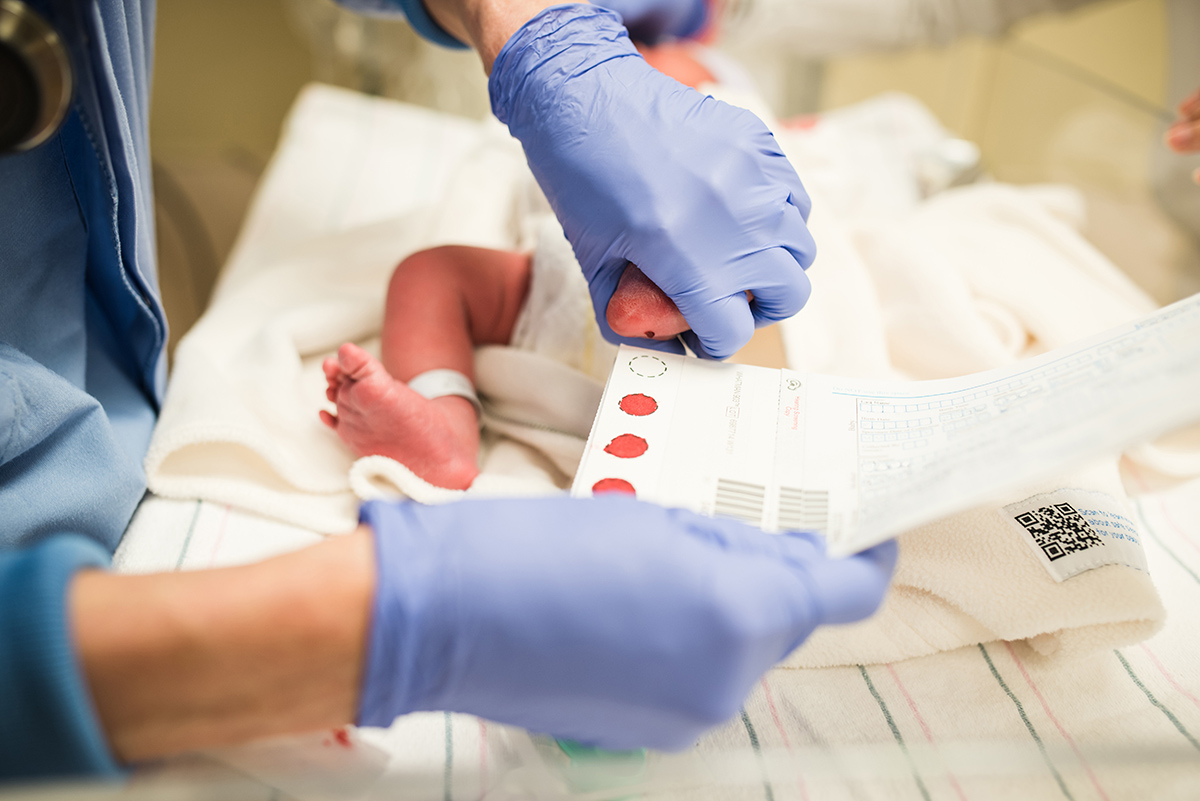
newborn receiving blood testCMV screening results

Below are the possible results that could be listed on the newborn screening report. Please note that there is decreased sensitivity in screening for CMV in dried blood spots, so not all infants with congenital CMV will be identified. Of those who are identified by newborn screening, up to 80% will be unaffected.

Within normal limits (CMV not detected)

  • This result means no additional follow-up is required. If CMV was not detected by screening, but a child has symptoms of congenital CMV, consultation with a pediatric infectious disease specialist is advised.
  • Results are returned to the provider who ordered the testing (birth hospital, midwife, or clinic).

Positive (CMV detected)

  • This result means further testing is needed to determine if your baby has congenital CMV.
  • Newborn Screening program staff will call your baby's doctor or clinic to inform them of the result and will recommend obtaining urine to confirm the screening result.
  • Your baby's doctor will contact you to discuss the next steps.

Note: If your baby receives a result not listed above, your baby’s doctor will discuss the result with you and tell you if further testing is needed.

Tags
  • newborn screening
Last Updated: 10/10/2025
  • Facebook
  • X
  • Instagram
  • LinkedIn
  • Youtube

About MDH

  • About Us
  • Grants and Loans
  • Advisory Committees

Legal & Accessibility

  • Privacy Policy
  • Equal Opportunity
  • Feedback Form

Careers at MDH

This is an official website of the State of Minnesota. Visit Minnesota.gov for more information.