
Secondary menu

  • About Us
  • News & Stories
  • Translated Materials
Minnesota Department of Health logo
  • Data, Statistics, and Legislation

    Data, Statistics, and Legislation

    Statistical reports, health economics, policy, and legislation.
    Data, Statistics, and Legislation
    • Community Health
    • Diseases and Conditions
    • Environmental Health
    • Health Behaviors and Risk Factors
    • Health Care Cost and Quality
    • Reporting and Exchanging Data
    • Legislation and Policy
  • Diseases and Conditions

    Diseases and Conditions

    A-Z disease listing, diseases and conditions by type.
    Diseases and Conditions
  • Health Care Facilities, Providers, and Insurance

    Health Care Facilities and Providers

    Directories of facilities, professional certifications, health insurance and patient safety.
    Health Care Facilities and Providers
    • Facility Certification, Regulation and Licensing
    • Insurance
    • Health Information Technology
    • Provider Certifications, Licenses, Registrations and Rosters
    • Patient Health and Safety
    • Health Care Homes
    • Notices Related to Health Records
    • Rural Health and Primary Care
    • Trauma System
  • Healthy Communities, Environments, and Workplaces

    Healthy Communities, Environments, and Workplaces

    Indoor air and drinking water quality, community prevention and emergency preparedness.
    Healthy Communities, Environments, and Workplaces
    • Community Wellness and Health Equity
    • Healthy Schools and Child Care
    • Healthy Businesses and Workplaces
    • Local Public Health
    • Environments and Your Health
    • Safety and Prevention
    • Emergency Preparedness and Response
    • Equitable Health Care Task Force
    • Transforming the Public Health System in Minnesota
  • Individual and Family Health

    Individual and Family Health

    Birth records, immunizations, nutrition and physical activity.
    Individual and Family Health
    • Vital Records and Certificates
    • Disabilities and Special Health Needs
    • Disease Prevention and Symptom Management
    • Healthy Aging
    • Healthy Children, Youth and Adolescents
    • Mental Health and Well-being
    • Reproductive Rights and Protections in Minnesota
    • Women and Infants
MDH Logo

Breadcrumb

  1. Home
  2. Healthy Communities, Environment and Workplaces
  3. Center For Public Health Practice
  4. Tools and Training From The Center For Public Health Practice
  5. Tools and Training - Public Health and QI Toolbox
Topic Menu

Center for Public Health Practice

  • Home: Center for Public Health Practice
  • Assistance & Workforce Development
  • Assessment & Planning
  • Connect
  • Funding Opportunities
  • Healthy Minnesota Partnership
  • Local Public Health Act
  • SCHSAC
  • Tools & Training
  • Contact Us

Related Sites

  • Minnesota Partners in Public Health Conference
  • Transforming Minnesota's Public Health System

Center for Public Health Practice

  • Home: Center for Public Health Practice
  • Assistance & Workforce Development
  • Assessment & Planning
  • Connect
  • Funding Opportunities
  • Healthy Minnesota Partnership
  • Local Public Health Act
  • SCHSAC
  • Tools & Training
  • Contact Us

Related Sites

  • Minnesota Partners in Public Health Conference
  • Transforming Minnesota's Public Health System
Contact Info
Center for Public Health Practice
651-201-3880
health.ophp@state.mn.us

Contact Info

Center for Public Health Practice
651-201-3880
health.ophp@state.mn.us

Tools and Training 
SWOT Analysis

On this page:
What is a SWOT analysis?
How to conduct a SWOT analysis
Examples
More information

What is a SWOT analysis?

A SWOT analysis provides programs and organizations with a clear, easy-to-read map of internal and external factors that may help or harm a project, by listing and organizing a project's strengths, weaknesses, opportunities, and threats. SWOT can clearly show a program its chances for success, given present environmental factors.

How to conduct a SWOT analysis

Create a chart with columns titled "Helpful" and "Harmful," and rows titled "Internal" and "External."
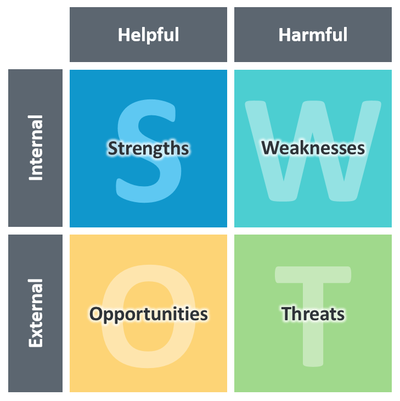
SWOT Analysis

Sort out factors that impact your organization, and place them in the appropriate rows/columns:

 HELPFUL 
(positive impact)
HARMFUL 
(negative impact)
Internal

Strengths may include:

  • Characteristics of the organization that will help it achieve successful outcome or reach goals
  • Resources, capabilities that will contribute to success

Weaknesses may include:

  • Characteristics of the organization that might hinder successful outcome / reaching goals
  • Absences of strengths
  • "Flip sides" of strengths
  • Things to avoid when executing program
  • Factors contributing to past failures
  • What other organizations might do better than yours
  • "Achilles Heels"
External

Opportunities may include:

  • Environmental factors that might influence/contribute to successful outcome
  • Unfulfilled / open niches not served by other programs (unmet customer need)
  • Upcoming changes to status quo (regulatory, political, social, etc.)
  • Chances made possible by unique strengths / eliminating weaknesses (?)
  • Factors: Political, Economic, Socio-cultural, Technological

Threats may include:

  • Environmental factors that might prevent successful outcome
  • Upcoming changes to status quo (regulatory, political, social, etc.)
  • Factors: Political, Economic, Socio-cultural, Technological

Remember:

  • Try to look at your organization from an external perspective, even when assessing internal factors: What would others say about your organization?
  • Try to verify/quantify statements when possible, rather than making general statements about your strengths, weaknesses, opportunities, and threats
  • You may end up with what seems like too many factors to consider, at which point it might be helpful to start prioritizing them
  • Consider: How can you convert weaknesses into strengths? Use strengths to overcome threats? Use strengths to maximize opportunities? Use strengths to compensate for or minimize weaknesses?
  • SWOT analyses can be performed on multiple levels of an organization: Might it be more helpful to perform one just on your program? division? a specific process?

Example SWOT analyses

Community Leadership Team SWOT Analysis (PDF)
Meeker-McLeod-Sibley Community Health Board
This SWOT analysis was conducted by Meeker-McLeod-Sibley in 2008, to inform development of a community leadership team within its SHIP-funded Healthy Communities Collaborative.

Appendix D: SWOT Analysis Results from Technical Teams (PDF)
ASTHO

St. Cloud State University Strategic Plan: SWOT Analysis
St. Cloud State University

More information

SWOT Analysis
Mind Tools

How to Perform SWOT Analysis
Bplans.com

Tags
  • public health practice
Last Updated: 07/24/2025
  • Facebook
  • X
  • Instagram
  • LinkedIn
  • Youtube

About MDH

  • About Us
  • Grants and Loans
  • Advisory Committees

Legal & Accessibility

  • Privacy Policy
  • Equal Opportunity
  • Feedback Form

Careers at MDH

This is an official website of the State of Minnesota. Visit Minnesota.gov for more information.