
Secondary menu

  • About Us
  • News & Stories
  • Translated Materials
Minnesota Department of Health logo
  • Data, Statistics, and Legislation

    Data, Statistics, and Legislation

    Statistical reports, health economics, policy, and legislation.
    Data, Statistics, and Legislation
    • Community Health
    • Diseases and Conditions
    • Environmental Health
    • Health Behaviors and Risk Factors
    • Health Care Cost and Quality
    • Reporting and Exchanging Data
    • Legislation and Policy
  • Diseases and Conditions

    Diseases and Conditions

    A-Z disease listing, diseases and conditions by type.
    Diseases and Conditions
  • Health Care Facilities, Providers, and Insurance

    Health Care Facilities and Providers

    Directories of facilities, professional certifications, health insurance and patient safety.
    Health Care Facilities and Providers
    • Facility Certification, Regulation and Licensing
    • Insurance
    • Health Information Technology
    • Provider Certifications, Licenses, Registrations and Rosters
    • Patient Health and Safety
    • Health Care Homes
    • Notices Related to Health Records
    • Rural Health and Primary Care
    • Trauma System
  • Healthy Communities, Environments, and Workplaces

    Healthy Communities, Environments, and Workplaces

    Indoor air and drinking water quality, community prevention and emergency preparedness.
    Healthy Communities, Environments, and Workplaces
    • Community Wellness and Health Equity
    • Healthy Schools and Child Care
    • Healthy Businesses and Workplaces
    • Local Public Health
    • Environments and Your Health
    • Safety and Prevention
    • Emergency Preparedness and Response
    • Equitable Health Care Task Force
    • Transforming the Public Health System in Minnesota
  • Individual and Family Health

    Individual and Family Health

    Birth records, immunizations, nutrition and physical activity.
    Individual and Family Health
    • Vital Records and Certificates
    • Disabilities and Special Health Needs
    • Disease Prevention and Symptom Management
    • Healthy Aging
    • Healthy Children, Youth and Adolescents
    • Mental Health and Well-being
    • Reproductive Rights and Protections in Minnesota
    • Women and Infants
MDH Logo

Breadcrumb

  1. Home
  2. Healthy Communities, Environment and Workplaces
  3. Center For Public Health Practice
  4. Tools and Training From The Center For Public Health Practice
  5. Tools and Training - Public Health and QI Toolbox
Topic Menu

Center for Public Health Practice

  • Home: Center for Public Health Practice
  • Assistance & Workforce Development
  • Assessment & Planning
  • Connect
  • Funding Opportunities
  • Healthy Minnesota Partnership
  • Local Public Health Act
  • SCHSAC
  • Tools & Training
  • Contact Us

Related Sites

  • Minnesota Partners in Public Health Conference
  • Transforming Minnesota's Public Health System

Center for Public Health Practice

  • Home: Center for Public Health Practice
  • Assistance & Workforce Development
  • Assessment & Planning
  • Connect
  • Funding Opportunities
  • Healthy Minnesota Partnership
  • Local Public Health Act
  • SCHSAC
  • Tools & Training
  • Contact Us

Related Sites

  • Minnesota Partners in Public Health Conference
  • Transforming Minnesota's Public Health System
Contact Info
Center for Public Health Practice
651-201-3880
health.ophp@state.mn.us

Contact Info

Center for Public Health Practice
651-201-3880
health.ophp@state.mn.us

Tools and Training 
Run Chart

On this page:
What is a run chart?
How to create a run chart
Using a run chart to test for special causes
Examples of run charts
Further reading
Sources

What is a run chart?

A run chart is used to study collected data for trends or patterns over a specific period of time. A run chart will help you:

  • Monitor data over time to detect trends, shifts, or cycles
  • Compare a measure before and after the implementation of solution to measure impact
  • Focus attention on vital changes, not normal variation
  • Track useful information for predicting trends

The run chart is a running record of a process over time:

  • The vertical axis represents the process being measured
  • The horizontal axis represents the units of time by which the measurements are made
  • The centerline of the chart is the mean or average

A run is defined as one or more consecutive data points on the same side of the mean line.

See Also: PH&QI Toolbox: Control Chart

How to create a run chart

  1. Choose which data you will measure and track
  2. Gather data: Generally, collect 20-25 data points, with which you can detect meaningful patterns over time
  3. Create a graph on which you can plot your data (y axis, or vertical line) over time (x axis, or horizontal line)
  4. Plot the data
  5. Interpret the chart: Focus on the vital changes or meaningful trends/patterns, rather than each and every data variation; keep reading for interpretation tips

Using a run chart to test for special causes

Test #1: The presence of too much or too little variability

Use when there are too few or too many runs.

Test #2: The presence of a shift in the process

A special cause exists if a run contains too many data points (i.e., with 20 or more data points, a run of 8 or more data points is considered "too long"; with less than 20 data points, a run of 7 might also be considered "too long").

Test #3: The presence of a trend

A trend is defined as an unusually long series of consecutive increases or decreases in the data, (usually at least 6 or 7).

Examples of run charts

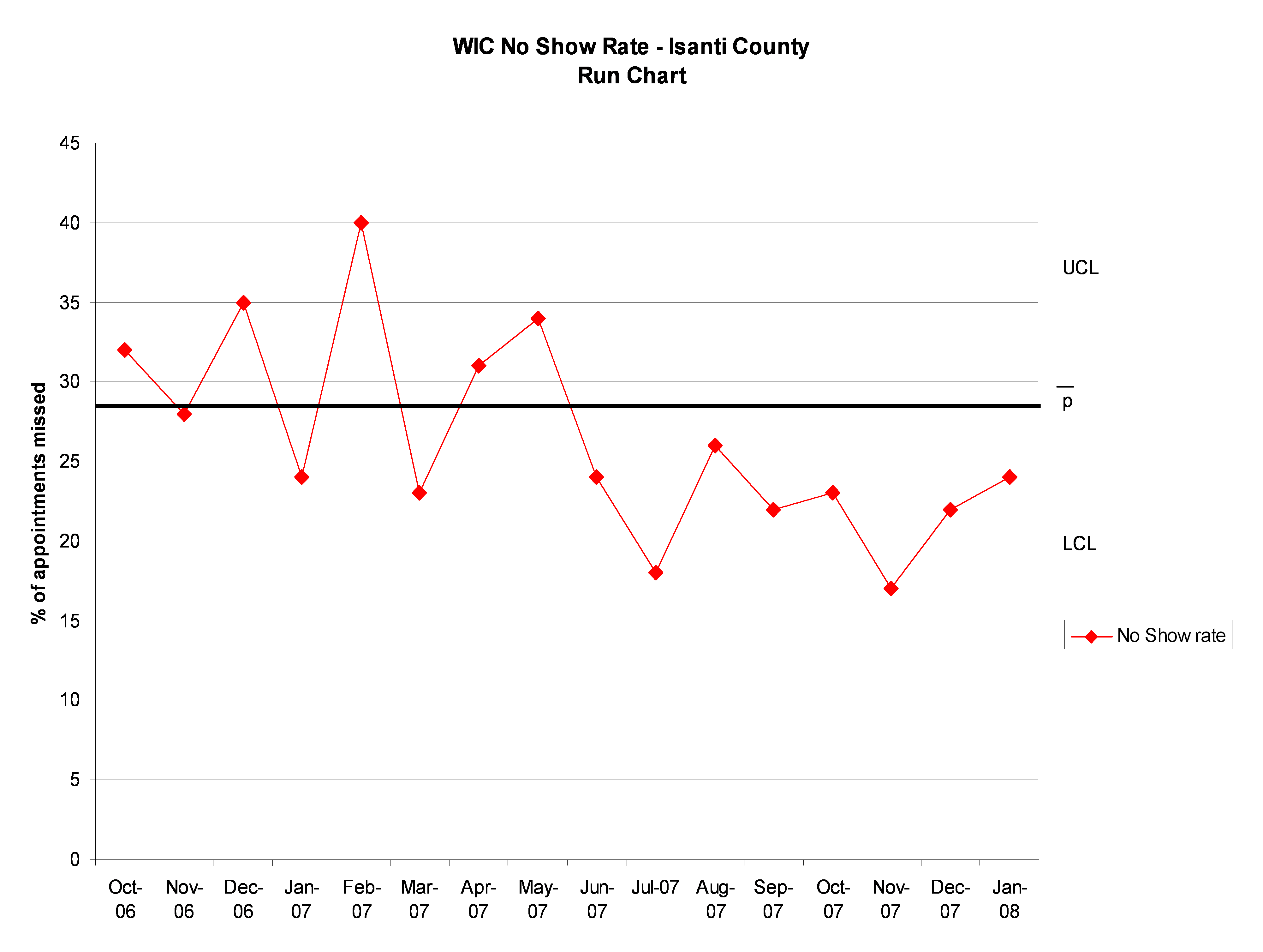
Isanti County, WIC no-show rate

This run chart from Isanti County shows the percentage of WIC appointments missed over a 1.5-year period.

Click to view larger image.
Run Chart

More examples of run charts

The Use of Control Charts in Health-Care and Public-Health Surveillance (PDF)
Journal of Quality Technology

Plotting Basic Control Charts: Tutorial Notes for Healthcare Practitioners (PDF)
Quality and Safety in Health Care

Further reading

Basics of the Control Chart (PDF)
MDH Office of Performance Improvement / UMN School of Public Health

Control Chart
American Society for Quality

The Control Chart: An Epidemiological Tool for Public Health Monitoring
Public Health

Finding the Right Tool for your Purpose (PDF) 
MDH Office of Performance Improvement

Sources

Public Health Memory Jogger
Public Health Foundation, GOAL/QPC

Basics of the Control Chart (PDF)
MDH Office of Performance Improvement / UMN School of Public Health

Tags
  • public health practice
Last Updated: 07/24/2025
  • Facebook
  • X
  • Instagram
  • LinkedIn
  • Youtube

About MDH

  • About Us
  • Grants and Loans
  • Advisory Committees

Legal & Accessibility

  • Privacy Policy
  • Equal Opportunity
  • Feedback Form

Careers at MDH

This is an official website of the State of Minnesota. Visit Minnesota.gov for more information.