
Secondary menu

  • About Us
  • News & Stories
  • Translated Materials
Minnesota Department of Health logo
  • Data, Statistics, and Legislation

    Data, Statistics, and Legislation

    Statistical reports, health economics, policy, and legislation.
    Data, Statistics, and Legislation
    • Community Health
    • Diseases and Conditions
    • Environmental Health
    • Health Behaviors and Risk Factors
    • Health Care Cost and Quality
    • Reporting and Exchanging Data
    • Legislation and Policy
  • Diseases and Conditions

    Diseases and Conditions

    A-Z disease listing, diseases and conditions by type.
    Diseases and Conditions
  • Health Care Facilities, Providers, and Insurance

    Health Care Facilities and Providers

    Directories of facilities, professional certifications, health insurance and patient safety.
    Health Care Facilities and Providers
    • Facility Certification, Regulation and Licensing
    • Insurance
    • Health Information Technology
    • Provider Certifications, Licenses, Registrations and Rosters
    • Patient Health and Safety
    • Health Care Homes
    • Notices Related to Health Records
    • Rural Health and Primary Care
    • Trauma System
  • Healthy Communities, Environments, and Workplaces

    Healthy Communities, Environments, and Workplaces

    Indoor air and drinking water quality, community prevention and emergency preparedness.
    Healthy Communities, Environments, and Workplaces
    • Community Wellness and Health Equity
    • Healthy Schools and Child Care
    • Healthy Businesses and Workplaces
    • Local Public Health
    • Environments and Your Health
    • Safety and Prevention
    • Emergency Preparedness and Response
    • Equitable Health Care Task Force
    • Transforming the Public Health System in Minnesota
  • Individual and Family Health

    Individual and Family Health

    Birth records, immunizations, nutrition and physical activity.
    Individual and Family Health
    • Vital Records and Certificates
    • Disabilities and Special Health Needs
    • Disease Prevention and Symptom Management
    • Healthy Aging
    • Healthy Children, Youth and Adolescents
    • Mental Health and Well-being
    • Reproductive Rights and Protections in Minnesota
    • Women and Infants
MDH Logo

Breadcrumb

  1. Home
  2. Healthy Communities, Environment and Workplaces
  3. Center For Public Health Practice
  4. Tools and Training From The Center For Public Health Practice
  5. Tools and Training - Public Health and QI Toolbox
Topic Menu

Center for Public Health Practice

  • Home: Center for Public Health Practice
  • Assistance & Workforce Development
  • Assessment & Planning
  • Connect
  • Funding Opportunities
  • Healthy Minnesota Partnership
  • Local Public Health Act
  • SCHSAC
  • Tools & Training
  • Contact Us

Related Sites

  • Minnesota Partners in Public Health Conference
  • Transforming Minnesota's Public Health System

Center for Public Health Practice

  • Home: Center for Public Health Practice
  • Assistance & Workforce Development
  • Assessment & Planning
  • Connect
  • Funding Opportunities
  • Healthy Minnesota Partnership
  • Local Public Health Act
  • SCHSAC
  • Tools & Training
  • Contact Us

Related Sites

  • Minnesota Partners in Public Health Conference
  • Transforming Minnesota's Public Health System
Contact Info
Center for Public Health Practice
651-201-3880
health.ophp@state.mn.us

Contact Info

Center for Public Health Practice
651-201-3880
health.ophp@state.mn.us

Tools and Training 
Pareto Chart

On this page:
What is a Pareto chart?
How to construct a Pareto chart
Example Pareto chart
More information
Sources

What is a Pareto chart?

A Pareto chart helps a team focus on problems that offer the greatest potential for improvement, by showing different problems' relative frequency or size in a descending bar graph, which highlights the problems' cumulative impact. Teams can then focus on problem causes that could have the greatest impact if solved or improved.

The Pareto principle: 20% of sources cause 80% of problems.

How to construct a Pareto chart

1. Choose problem, potential causes

Select a problem for your team to analyze.

Next, choose potential problem causes, which your team will monitor, compare, and rank-order with an affinity diagram, or by using existing data.

2. Choose measurement units

Choose units of measurement common across all potential causes, like cost or frequency.

Choose a time period long enough to accurately represent the situation. Remember, the interval should take seasonality into account, as well as different patterns within days, weeks, or months.

3. Gather data

Gather data on your team's variables, and store in a spreadsheet.

4. Construct Pareto chart

Start to draft the Pareto chart: the chart's horizontal axis contains the problem categories and the vertical axis contains the measurement (cost, frequency, etc.).

Arrange the bars in descending order to assess which problem causes are occurring in the greatest amount—and therefore have the greatest potential to positively impact your problem if solved or improved.

You might also wish to draw a line that shows the cumulative total of each problem cause, as you progress across the chart. This line might help you assess which sources are causing "80% of the problems."

Example Pareto chart
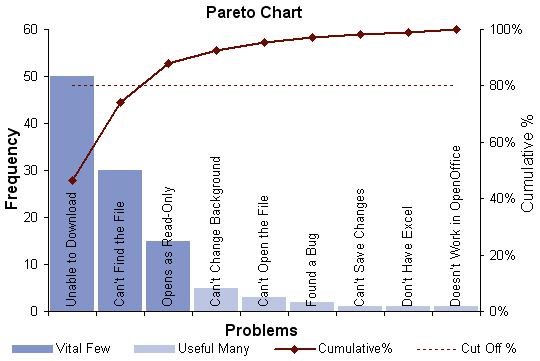
Goomedic Pareto Chart

Source: Goomedic

More information

Pareto Chart
Institute for Healthcare Improvement

Pareto Charts
USAID Assist Project

Pareto Charts
American Society for Quality

Pareto Analysis and Check Sheets
Oregon State Extension Service

Finding the Right Tool for your Purpose (PDF)
MDH Office of Performance Improvement

Pareto Chart [Note: Video will autoplay]
Western Regional Public Health Training Center

Source

Public Health Memory Jogger
Public Health Foundation, GOAL/QPC

Tags
  • public health practice
Last Updated: 12/31/2025
  • Facebook
  • X
  • Instagram
  • LinkedIn
  • Youtube

About MDH

  • About Us
  • Grants and Loans
  • Advisory Committees

Legal & Accessibility

  • Privacy Policy
  • Equal Opportunity
  • Feedback Form

Careers at MDH

This is an official website of the State of Minnesota. Visit Minnesota.gov for more information.