Secondary menu

  • About Us
  • News & Stories
  • Translated Materials
Minnesota Department of Health logo
  • Data, Statistics, and Legislation

    Data, Statistics, and Legislation

    Statistical reports, health economics, policy, and legislation.
    Data, Statistics, and Legislation
    • Community Health
    • Diseases and Conditions
    • Environmental Health
    • Health Behaviors and Risk Factors
    • Health Care Cost and Quality
    • Reporting and Exchanging Data
    • Legislation and Policy
  • Diseases and Conditions

    Diseases and Conditions

    A-Z disease listing, diseases and conditions by type.
    Diseases and Conditions
  • Health Care Facilities, Providers, and Insurance

    Health Care Facilities and Providers

    Directories of facilities, professional certifications, health insurance and patient safety.
    Health Care Facilities and Providers
    • Facility Certification, Regulation and Licensing
    • Insurance
    • Health Information Technology
    • Provider Certifications, Licenses, Registrations and Rosters
    • Patient Health and Safety
    • Health Care Homes
    • Notices Related to Health Records
    • Rural Health and Primary Care
    • Trauma System
  • Healthy Communities, Environments, and Workplaces

    Healthy Communities, Environments, and Workplaces

    Indoor air and drinking water quality, community prevention and emergency preparedness.
    Healthy Communities, Environments, and Workplaces
    • Community Wellness and Health Equity
    • Healthy Schools and Child Care
    • Healthy Businesses and Workplaces
    • Local Public Health
    • Environments and Your Health
    • Safety and Prevention
    • Emergency Preparedness and Response
    • Equitable Health Care Task Force
    • Transforming the Public Health System in Minnesota
  • Individual and Family Health

    Individual and Family Health

    Birth records, immunizations, nutrition and physical activity.
    Individual and Family Health
    • Vital Records and Certificates
    • Disabilities and Special Health Needs
    • Disease Prevention and Symptom Management
    • Healthy Aging
    • Healthy Children, Youth and Adolescents
    • Mental Health and Well-being
    • Reproductive Rights and Protections in Minnesota
    • Women and Infants
MDH Logo

Breadcrumb

  1. Home
  2. Healthy Communities, Environment and Workplaces
  3. Emergency Preparedness and Response
  4. Medical Countermeasures
Topic Menu

Emergency Preparedness and Response

  • Emergency Preparedness Home
  • Family and Community Preparedness
  • Disaster Mental/Behavioral Health
  • HAN
  • Medical Countermeasures
  • Plans
  • Minnesota Responds
  • Training & Exercises
  • Health Care Coalitions
  • Long-Term Care
  • Medical Surge
  • About EPR

Emergency Preparedness and Response

  • Emergency Preparedness Home
  • Family and Community Preparedness
  • Disaster Mental/Behavioral Health
  • HAN
  • Medical Countermeasures
  • Plans
  • Minnesota Responds
  • Training & Exercises
  • Health Care Coalitions
  • Long-Term Care
  • Medical Surge
  • About EPR
Contact Info
Emergency Preparedness and Response
651-201-5700
Emergency Preparedness & Response Comment Form

Contact Info

Emergency Preparedness and Response
651-201-5700
Emergency Preparedness & Response Comment Form

Strategic National Stockpile CHEMPACK Program

PDF version formatted for print: Strategic National Stockpile CHEMPACK Program (PDF)

The CHEMPACK program is a national, voluntary program, overseen by the Administration for Strategic Preparedness and Response’s Strategic National Stockpile as a necessary function of the nation’s defense against terrorism.

CHEMPACKs are containers of nerve agent antidotes and supplies that can be quickly accessed by first responders and medical professionals in a chemical incident. These antidotes can quickly be administered in lifesaving situations during the release of nerve agents in a public health emergency.

The toxic effects of nerve agents may be immediate or delayed for many hours depending on agent and route of exposure. Complete decontamination and immediate pharmaceutical intervention for severely exposed patients are the best countermeasures to reduce mortality. Long-term in a hospital with significant additional pharmaceutical and supportive care is often required in significant exposures.

Type of CHEMPACK Containers

  • EMS CHEMPACK holds enough supplies to treat approximately 454 patients and has a higher percentage of pre-load medications (auto-injector) and a lower percentage of multi-dose vials.
  • Hospital CHEMPACK holds enough supplies to treat approximately 1,000 patients and has a higher percentage of multi-dose vials and a lower percentage of pre-load medication.

Medications in CHEMPACK containers work by treating the symptoms of nerve agent exposure and can be used even when the actual agent is unknown. CHEMPACK antidotes are regularly tested for potency and are replaced when needed.

The CHEMPACK formulary consists of medication that:

  • Treats excess secretions caused by nerve agents, for example, excess saliva, tears, urine, vomiting, and diarrhea.
  • Treats symptoms such as high blood pressure, rapid heart rate, weakness, muscle tremors, and paralysis.
  • Treats and can prevent seizures.

What this means for Minnesota

  • Minnesota has selected and staged its CHEMPACK containers based on the amount and variety assets allocated, hazard vulnerability analysis, public health regional planning and placement sites meeting the strict criteria for the Program.   
  • The antidotes are either replaced by ASPR at or before their expiration date or the assets are eligible for the Shelf Life Extension Program to assure the assets are safe and effective. MDH serves as a liaison to the host sites and to ASPR during these sustainment operations.
  • MDH assists in emergency response planning for the CHEMPACK program assets by providing guidance, review, and subject matter expertise. 

EMS and Hospital Containers in Metro and Greater Minnesota

Region/TypeEMS ContainersHospital Containers
Metro146
Greater Minnesota77

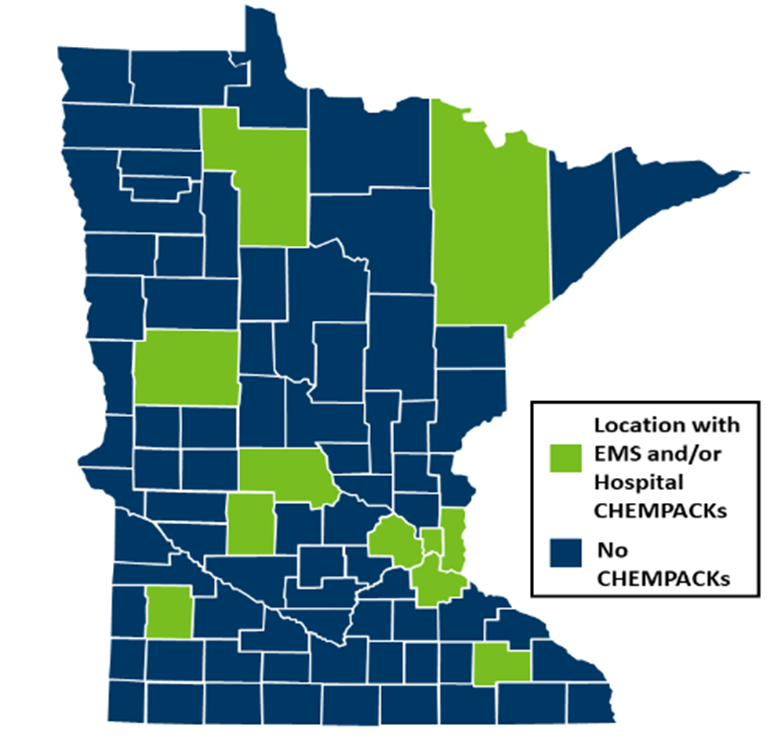
Map of public health preparedness districts.

State of Minnesota map highlighting 11 counties that have EMS and/or hospital CHEMPACK containers including: Beltrami, St. Louis, Otter Tail, Stearns, Kandiyohi, Lyon, Hennepin, Anoka, Ramsey, Dakota, and Washington.

For More Information

  • CDC Bioterrorism (https://emergency.cdc.gov/bioterrorism/)


Tags
  • emergency preparedness
Last Updated: 07/07/2025
  • Facebook
  • X
  • Instagram
  • LinkedIn
  • Youtube

About MDH

  • About Us
  • Grants and Loans
  • Advisory Committees

Legal & Accessibility

  • Privacy Policy
  • Equal Opportunity
  • Feedback Form

Careers at MDH

This is an official website of the State of Minnesota. Visit Minnesota.gov for more information.