
Contact Info
Inter-Coalition Communications Guidance
PDF version formatted for print: Inter-Regional Communications Guidance (PDF)
Updated 4/18/2022
The Inter-Coalition Communications Guidelines aims to establish a communication framework for all eight Minnesota Health Care Coalitions (HCC) to implement when resources exceed capacity or incident exceeds HCC boundaries. The plan provides guidance on communication flow among Regional Health Care Preparedness Coordinators (RHPCs). This guideline is framed as a Response-Peer system where peers may be asked to collect, vet or disseminate information as instructed by the impacted HCC.
Assumptions
- Each HCC will include Response-Peer(s) in situational awareness communications, as appropriate.
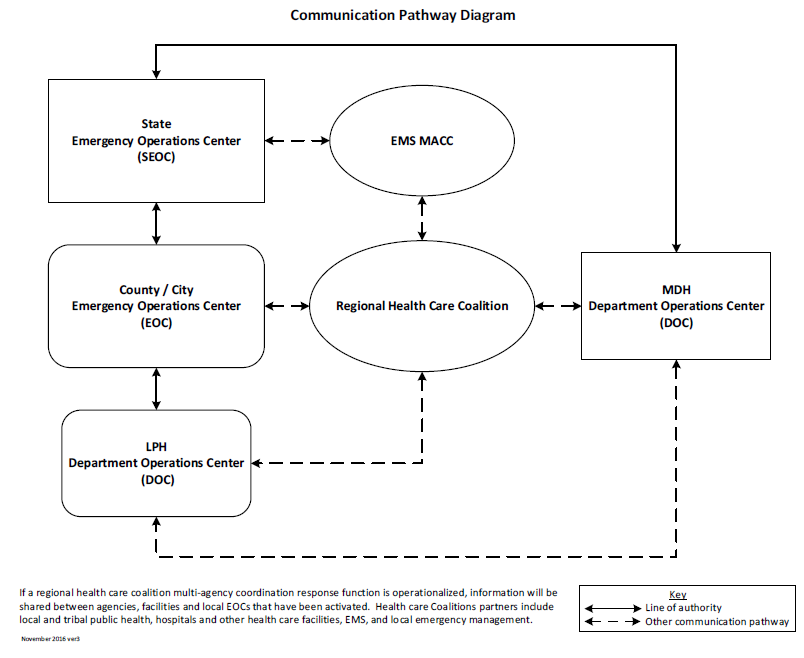
- Impacted HCC will follow “formal communication” process with respective response partners based on chain of command. See Attachment 2: Communication Pathway Diagram.
- These recommendations are meant to be agile.
- These recommendations may be implemented at any stage of an incident and therefore are not tied to a specific response timeframe.
HCC Response Peer Framework
Response peer pairing: At the discretion of the impacted HCC, one or more HCCs may be asked to serve in the Response Peer capacity.
Roles and Responsibilities
Impacted HCC
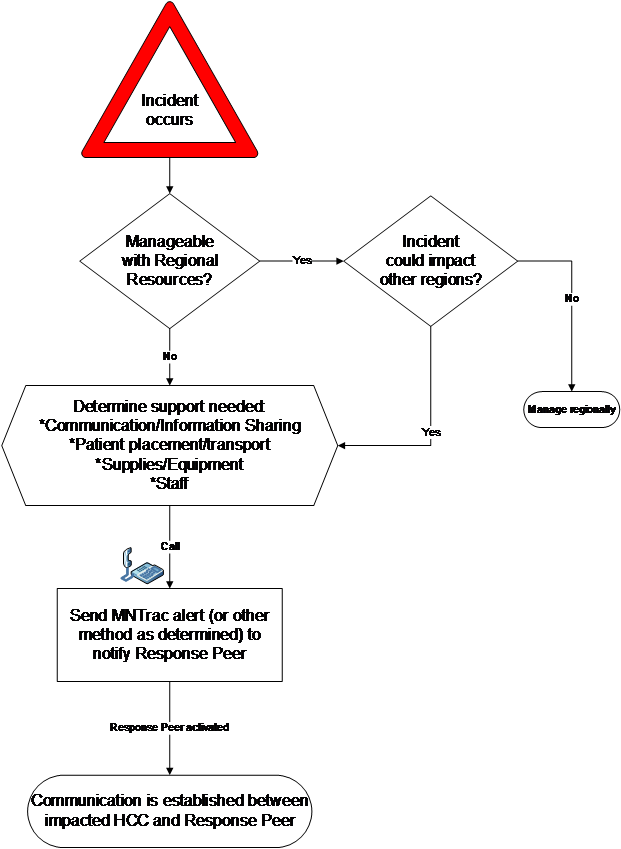
- Determine if Response Peer assistance is required (Reference Attachment 1: Activating Response Peer Decision Tree)
- Include HCC Response Peer in notification communications when in incident occurs that may require a regional response.
- Provide situational awareness to Response Peer and response needs to be covered.
- Keep HCC Response Peer updated regarding the situation and any changes that would impact the tasks assigned to the peer. (It is recommended that the Response Peer be included in situation update briefings held within the HCC. This may be by conference call.)
HCC Response-Peer (will vary based on incident needs):
- Assist in compiling, vetting and/or disseminating information, including but not limited to:
- Situational Awareness
- Resource requests
Available resources (Note: This will normally be focused on communication with partners outside the impacted HCC such as MDH, other HCCs, etc.)
- Provide MNTrac support (e.g. requesting/compiling bed availability, creating/disseminating reports, managing/supporting command center, etc.)
- Serve as a support partner as directed by impacted HCC
Notification Procedures
- Impacted HCC will follow normal communication practices with MDH-CEPR (Reference Attachment 2: Communication Pathway Diagram).
- Impacted HCC may lean forward to initiate communications with a peer for assistance. That peer will then notify the rest of the RHPC’s of the situation, point of contact, and/or needs.
Essential Elements of Information
The following are types of essential elements of information that may be shared or gathered during an incident.
EEI Category |
Specific Information |
Data Source |
Information Sharing Mechanism |
Information Validation Mechanism |
|---|---|---|---|---|
Facility Status |
Availability of offered services, Status of infrastructure/ facility systems. |
Coalition |
MNTrac, Survey, Phone, Fax, Email, ARMER |
Phone, ARMER |
Resource Status |
Needs and availability |
Coalition |
MNTrac, Survey, Phone, Fax, Email, ARMER |
Phone, ARMER |
Patient Movement |
Patient health status, location, disposition, transfer and transportation status. |
Hospitals, EMS agencies |
MNTrac, Phone, Fax, ARMER |
Phone, Fax, ARMER, MNTrac CC |
Bed availability |
Availability of rooms: |
Hospitals, LTC |
MNTrac, Survey, Phone, Fax, Email, ARMER |
Phone, Fax, Email, ARMER |
Attachment 1: Activating Response Peer Decision Tree
Attachment 2: Communication Pathway Diagram
Attachment 3: Key Information for Initial Communication Process
Description of Table
HCC 24/7 Phone Number: This is the HCC 24/7 call-in information.
Initial HCC Connection: This information outlines how HCC leaders are initially contacted regarding a response request from local partners.
- Who: This column outlines what partner is responsible to connect with the HCC response leaders (e.g. HMAC, MAC, etc.).
- Method: Primary/Secondary – This outlines the communication platform used in communicating with HCC decision-making response leaders, upon request of activating HCC.
| HCC | 24/7 Phone Number | Primary Communicator | Communication Method |
|---|---|---|---|
C |
(320) 654-2720 |
RHPC |
Phone, MNTrac |
M |
612-873-9911 |
RHPC |
Phone, MNTrac |
NE |
Jo Thompson: |
RHPC |
Phone, MNTrac |
NW |
Amy Card: |
RHPC |
Phone, MNTrac |
SC |
Eric Weller: |
RHPC |
Phone, MNTrac |
SE |
855-606-5458 |
ECC |
Phone: 855-606-5458 |
SW |
1-800-259-0195 (24/7) 320-769-4470 Office |
RHPC |
Email |
WC |
(320) 654-2720 |
RHPC |
Phone, MNTrac |