
Secondary menu

  • About Us
  • News & Stories
  • Translated Materials
Minnesota Department of Health logo
  • Data, Statistics, and Legislation

    Data, Statistics, and Legislation

    Statistical reports, health economics, policy, and legislation.
    Data, Statistics, and Legislation
    • Community Health
    • Diseases and Conditions
    • Environmental Health
    • Health Behaviors and Risk Factors
    • Health Care Cost and Quality
    • Reporting and Exchanging Data
    • Legislation and Policy
  • Diseases and Conditions

    Diseases and Conditions

    A-Z disease listing, diseases and conditions by type.
    Diseases and Conditions
  • Health Care Facilities, Providers, and Insurance

    Health Care Facilities and Providers

    Directories of facilities, professional certifications, health insurance and patient safety.
    Health Care Facilities and Providers
    • Facility Certification, Regulation and Licensing
    • Insurance
    • Health Information Technology
    • Provider Certifications, Licenses, Registrations and Rosters
    • Patient Health and Safety
    • Health Care Homes
    • Notices Related to Health Records
    • Rural Health and Primary Care
    • Trauma System
  • Healthy Communities, Environments, and Workplaces

    Healthy Communities, Environments, and Workplaces

    Indoor air and drinking water quality, community prevention and emergency preparedness.
    Healthy Communities, Environments, and Workplaces
    • Community Wellness and Health Equity
    • Healthy Schools and Child Care
    • Healthy Businesses and Workplaces
    • Local Public Health
    • Environments and Your Health
    • Safety and Prevention
    • Emergency Preparedness and Response
    • Equitable Health Care Task Force
    • Transforming the Public Health System in Minnesota
  • Individual and Family Health

    Individual and Family Health

    Birth records, immunizations, nutrition and physical activity.
    Individual and Family Health
    • Vital Records and Certificates
    • Disabilities and Special Health Needs
    • Disease Prevention and Symptom Management
    • Healthy Aging
    • Healthy Children, Youth and Adolescents
    • Mental Health and Well-being
    • Reproductive Rights and Protections in Minnesota
    • Women and Infants
MDH Logo

Breadcrumb

  1. Home
  2. Healthy Communities, Environment and Workplaces
  3. Environments and Your Health
  4. Minnesota Biomonitoring: Chemicals In People
  5. Minnesota Biomonitoring Projects
Topic Menu

Biomonitoring

  • Biomonitoring Home
  • About Biomonitoring
  • Biomonitoring Projects
  • Biomonitoring Reports
  • Advisory Panel
  • Biomonitoring and Tracking Legislation

Related Sites

  • Minnesota Tracking Program
  • MN Public Health Data Access Portal
  • Contaminant and Chemical Information

Environmental Health Division

  • EH Division Home

Biomonitoring

  • Biomonitoring Home
  • About Biomonitoring
  • Biomonitoring Projects
  • Biomonitoring Reports
  • Advisory Panel
  • Biomonitoring and Tracking Legislation

Related Sites

  • Minnesota Tracking Program
  • MN Public Health Data Access Portal
  • Contaminant and Chemical Information

Environmental Health Division

  • EH Division Home
Contact Info
Minnesota Tracking and Biomonitoring Program
651-201-5662
health.biomonitoring@state.mn.us

Contact Info

Minnesota Tracking and Biomonitoring Program
651-201-5662
health.biomonitoring@state.mn.us

PFAS Biomonitoring in the East Metro

Per- and Polyfluoroalkyl substances (PFAS) are also referred to as perfluorochemicals (PFCs).

Per- and polyfluoroalkyl substances or PFAS are chemicals that have been used for many years to make products that resist stains, grease, water and heat. In the early 2000s, some drinking water sources in the East Metro – a suburban area east of St. Paul– were found to be polluted with PFAS. A public health intervention in 2006, including installing filtration systems for polluted public and private wells, reduced PFCs in drinking water.

Since 2008, MDH has done three projects testing blood levels of PFAS in people who live in the East Metro as directed by the Minnesota Legislature. The most recent results are from MDH’s third PFAS biomonitoring project, which tested blood levels of PFAS in over 300 residents of Oakdale, Lake Elmo and Cottage Grove, Minnesota in 2014.
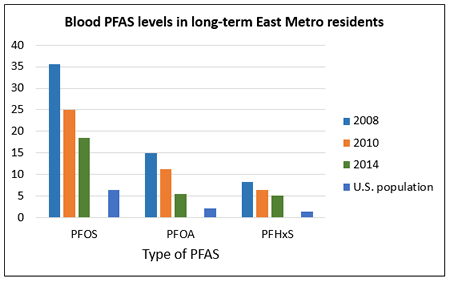
This is a chart of the blood PFAS levels in long-term East Metro residents compared to the US population in 2008, 2010 and 2014.

Results from these three studies found:

  • PFAS blood levels are going down in long-term residents who were exposed to PFAS in drinking water before the public health interventions in 2006 (see graph above). Blood levels in these residents are still higher than in the background U.S. population.
  • PFAS levels in newer residents are similar to levels seen elsewhere in the U.S. These people moved to Oakdale after the intervention.

For more information

  • Report to the Community 2015, (PDF) with results from third biomonitoring project.
  • Report to the Community 2011, (PDF) with results from second biomonitoring project: results from blood testing (PDF) and survey responses 2013, (PDF).
  • Reports to the Community 2009, (PDF) with results from first biomonitoring project: results from blood testing and blood v. water levels 2010, (PDF).
  • Updated report on cancer incidence in Dakota and Washington Counties 2015, (PDF).
  • More on PFAS in Minnesota
    • Per- and Polyfluoroalkyl Substances (PFAS) - Learn more
    • Cancer incidence in Dakota and Washington Counties, 2015 (PDF)

These results have also been published in a scientific journal. The full article requires a subscription to read – contact us for access: health.biomonitoring@state.mn.us or 651-201-5900.

Related links

About Biomonitoring

Biomonitoring Reports

Minnesota Environmental Public Health Tracking

Tags
  • environment
Last Updated: 10/14/2024
  • Facebook
  • X
  • Instagram
  • LinkedIn
  • Youtube

About MDH

  • About Us
  • Grants and Loans
  • Advisory Committees

Legal & Accessibility

  • Privacy Policy
  • Equal Opportunity
  • Feedback Form

Careers at MDH

This is an official website of the State of Minnesota. Visit Minnesota.gov for more information.