
2026 Public Health Laboratory Newsroom
Hundreds of Minnesotan Newborns Helped by Hearing Screening Every Year
Almost every baby born in Minnesota undergoes hearing screening soon after birth. Because of these screens, an average of 181 Minnesota children per year are later diagnosed with permanent congenital hearing loss. Another 100 or so per year prove to have temporary hearing loss. (See more newborn hearing screening data.)
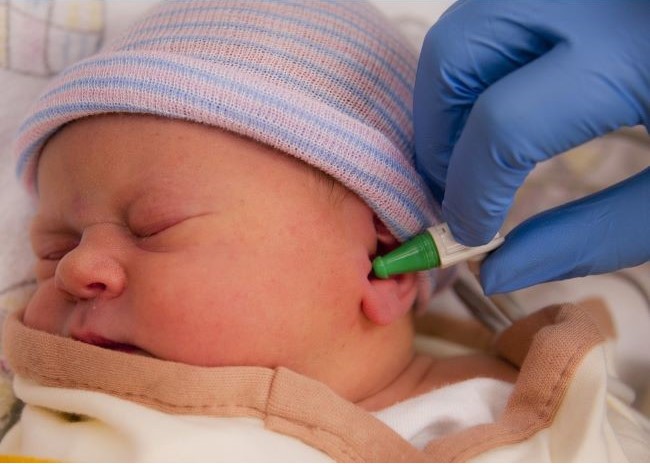 Hearing screening is a simple and painless procedure that does not require newborns to be awake or respond in any way. It cannot diagnose hearing loss alone, however. Any indication that there may be a hearing difference must be confirmed by further testing. (Read more at Screening Basics and Frequently Asked Questions.)
The Minnesota Newborn Screening Program, a section of the Minnesota Public Health Laboratory, manages hearing screening for newborns. It gathers hearing screening results from hospitals, clinics, and midwives, and then coordinates with primary care providers and audiologists and other specialists to ensure any further testing is in place.
The Importance of Hearing Screening
The first year of a child’s life is a critical time for developing language and other cognitive abilities. Most babies learn the foundations of language by being exposed to verbal or visual language long before producing it themselves. Hearing screening and diagnostic follow-up by a pediatric audiologist is the only reliable method for determining how much a child under the age of two can hear.
Newborns who have temporary hearing loss usually have a buildup of fluid in the middle ear. If the excess fluid does not clear up, an ear, nose and throat specialist can remove it through surgery.
Some babies diagnosed with permanent congenital hearing loss can be offered a medical or surgical treatment, such as when the outer ear canal was not fully formed (i.e, atresia (PDF)). Some can be offered amplification devices to improve their ability to hear spoken language.
Learning sign language early can greatly benefit families who want to provide their baby with visual access to language. There are many free ways to learn sign language and research has shown learning sign language does not hinder spoken language development.
Through organizations like Minnesota Hands and Voices, newborns’ families connect with other families who have children with hearing differences. Minnesota has a strong and supportive community of people who are deaf or hard of hearing. All children with hearing loss are eligible for early intervention.
It is important to note that some babies who pass their newborn hearing screen have a risk factor for late onset hearing loss. Parents should talk to their providers about when their children should be tested again. Parents can always request another test whenever they have concerns about their child’s hearing.
History of Newborn Screening in Minnesota
Hospitals began conducting hearing screening on newborns in the 1990s. It was voluntary and unfunded, and too often follow-up did not occur. Babies with hearing differences frequently did not get the further testing or interventions that would help them develop language and other cognitive abilities. Once they were diagnosed with hearing differences around two years of age, a critical window for language acquisition had passed.
In 2007, the Minnesota legislature enacted a law (Sec. 144.966 MN Statutes) that gave the Minnesota Newborn Screening Program a critical role in newborn hearing screening. Hospitals were mandated to carry out newborn hearing screening and report results to the Minnesota Newborn Screening Program. The program tracks results and connects primary care providers and families with further testing, information, and other resources.
The Minnesota Newborn Screening Program’s baseline goal for every Minnesota newborn aligns with the national goal for all newborn screening programs and early hearing detection and intervention programs, including the Minnesota Early Hearing Detection and Intervention Program (EHDI). It is:
- By 1 month old, hearing screening is complete.
- By 3 months old, a full diagnostic assessment is complete.
- By 6 months old, the newborn has full access to language and early intervention programs.
The cases of babies with permanent hearing loss are given to the Longitudinal Follow-Up for Newborn Screening Conditions program, within the Children and Youth with Special Health Needs (CYSHN) section of the Minnesota Department of Health. This program helps connect children with hearing differences and their families to the supports they need.
Return to the 2026 Public Health Laboratory Newsroom.